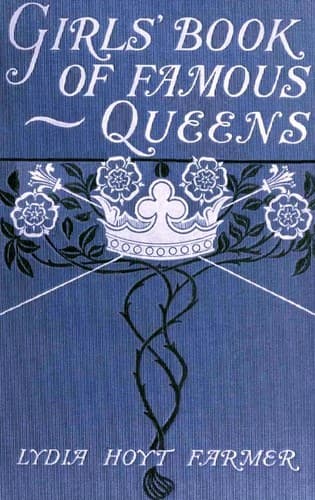
The Girls' Book of Famous QueensFarmer, Lydia Hoyt
History
The Girls' Book of Famous Queens
Farmer, Lydia Hoyt
Queens -- Biography -- Juvenile literature
All the palace, all Vienna, was full of excitement. The loyal affection
and sentimental lamentation of the inhabitants gave vent to themselves
in cries of grief. For the fair young daughter of their empress, in
whose coming exaltation they took the utmost pride, who was to do them
such honor and service at the court of France, she whose bright face
ever beamed with smiles, was, on this 21st of April, 1770, departing
on her long journey, and, as many without much prophetic insight might
have perceived, her difficult career. When the great coach rolled from
the palace courtyard, the girl-bride covered her face with her hands,
which yet could not conceal the tears that streamed through her slender
fingers. Again and again she turned for a farewell look at the mother,
the home, and the early friends, which she was never to see again. The
carriage rolled away, and Marie Antoinette Jeanne Josèphe de Lorraine
turned her back forever on the Prater and the Danube, Schönbrunn and
the moated Laxenburg.
Spring-time in sunny France; the birds are singing merrily, the
trees are putting forth their leaves, and all nature wears a look of
happiness and joy. The Château de Compiègne is filled with guests,—a
brilliant assemblage of the _haute noblesse_ composing the court of
Louis XV. Upon the terrace stands the king, and with him his three
grandsons,—the Dauphin (Louis XVI.), Monsieur le Comte de Provence
(Louis XVIII.), and the Comte d’ Artois (Charles X.),—and an eager,
anxious crowd surrounds them. All gaze in one direction, for Louis,
the Dauphin, awaits his bride,—she who is to be the future queen of
France. But little like a bridegroom looks the timid, fat Louis, upon
this bright spring morning. He wears an air of resigned indifference,
contrasting strongly with the eagerness of his Majesty, King Louis
XV., who, notwithstanding his sixty years, makes a far more gallant
knight than he. There is a cloud of dust upon the horizon; the
_avant-couriers_ arrive; the king and the Dauphin mount their horses,
and with a numerous retinue ride forth to meet and welcome the
approaching bride. And now the old state travelling carriage is in
sight. Putting spurs to his horse, the king leads the way, and, hat
in hand, rides up to the side of the cumbrous vehicle. The door flies
open, and before him in all the freshness of her fifteen summers is
Marie Antoinette Jeanne Josèphe de Lorraine, Archduchess of Austria.
The introductions follow, and the young bride and her bashful _fiancée_
are conducted back to Versailles, where, on the 16th of May, 1770, the
nuptial benediction is pronounced by the Archbishop of Paris, in the
chapel of the palace.
Then followed the _fêtes_, and notwithstanding the exchequer was in the
usual chronic state of exhaustion, twenty millions of francs—a mighty
sum for that period—was spent upon them.
Public-domain text, read in full here on John Shaqi.
Reviews
Reviews
No reviews yet
Be the first to share your thoughts on this work.
Elsewhere in the archive
Join the Discussion
Join the discussion
Sign in to leave a comment or review.
Sign InorCreate an account