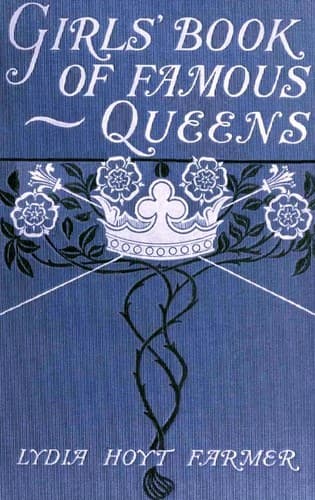
The Girls' Book of Famous QueensFarmer, Lydia Hoyt
History
The Girls' Book of Famous Queens
Farmer, Lydia Hoyt
Queens -- Biography -- Juvenile literature
“I have received your letter, in which you seem to reproach me for
speaking ill of women. It is true that I dislike female intriguers
above all things. I am used to kind, gentle, and conciliatory women.
I love them, and if they have spoiled me, it is not my fault, but
yours. However, you will see that I have done an act of kindness to
one deserving woman. I allude to Madame de Hatzfeld. When I showed
her her husband’s letter, she stood weeping, and in a tone of mingled
grief and ingenuousness, said, ‘It is indeed his writing!’ This went
to my heart, and I said: ‘Well, madame, throw the letter into the
fire, and then I shall have no proof against your husband.’ She burned
the letter, and was restored to happiness. Her husband now is safe;
two hours later, and he would have been lost. You see, therefore, that
I like women who are simple, gentle, and amiable; because they alone
resemble you.”
Josephine’s kindness and consideration for the comfort of every one in
her household, even down to the lowest menial, was proverbial. When
travelling with Napoleon, a picket-guard was appointed by the emperor
for her service. One cold night, in the early dawn, she heard marching
and coughing under her window. She wondered who could be out so late
in the chill of that hour; and upon inquiry, she learned that it was
the sentinel posted there. She thereupon sent for the officer of the
guard, and said to him, “Sir, I have no need of a sentinel at night;
these brave men have endured enough in the army when they followed it
to the wars; they must rest while in my service. I don’t want them to
catch cold.” The officer, smiling at the apprehensive solicitude of
the empress, and touched by her unexpected kindness, dismissed the
sentinel, and his place was not supplied.
Napoleon is said to have talked but little. When out of his own house,
if he chanced to stop and speak with any one, it was considered of
enough importance to be remarked and reported. The following is
Josephine’s portrait of Napoleon at home: “He had a fine intellect, a
sensible and grateful heart, simple tastes, and the qualities of an
amiable man; to the sentiments of an honest man, he united a prodigious
local memory.”
When Josephine spoke of her husband, she always said, “The emperor
says,” “the emperor wishes,” “the emperor orders,” etc. She very
rarely called him by name in public, and in private she called him
Bonaparte; while her tender name for him was _mon ami_. When speaking
of her, Napoleon usually called her _the empress_, or he would say,
“I am going to see _my wife_”; but in addressing her he called her
_Josephine_, unless he spoke with severity or on some serious occasion,
when he called her _Madame_, without other title or name.
Public-domain text, read in full here on John Shaqi.
Reviews
Reviews
No reviews yet
Be the first to share your thoughts on this work.
Elsewhere in the archive
Join the Discussion
Join the discussion
Sign in to leave a comment or review.
Sign InorCreate an account