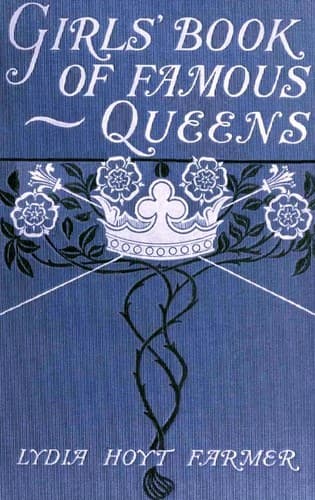
The Girls' Book of Famous QueensFarmer, Lydia Hoyt
History
The Girls' Book of Famous Queens
Farmer, Lydia Hoyt
Queens -- Biography -- Juvenile literature
On the day of the ambassador’s public presentation at court, Josephine,
arrayed in all her imperial magnificence, received him with a gracious
smile. The poor, dumfounded Persian, who recognized in the empress the
woman whom he had vainly tried to captivate, was completely amazed, and
his manner and attitude expressed his astonished mortification.
But Josephine, with winning smile, quickly relieved him of his
embarrassment, saying, in her sweet persuasive tones:—
“You must admit, Monsieur l’Ambassadeur, that I had good reason for
telling you that I preferred to remain in France. If you think well of
me, you will remain faithful to that beautiful wife of yours.” And with
a sign of respect, the humiliated Persian withdrew.
At Josephine’s early receptions as wife of the First Consul, the
costumes of the guests were very heterogeneous in style. The fashions
of the Republic had been copied after ancient Greek and Roman styles;
and the ladies of the Republic flaunted their Grecian tunics and Roman
sandals with great pride. But after a time it was remarked “that
military boots and pantaloons, clanking swords and cockades, were in
a considerable minority, and that silk stockings, shoes with buckles,
dress swords, and _chapeaux sous le bras_ were the rule. Some of the
company had, however, endeavored to spare their feelings too complete a
shock, by an attempt to unite the past and the present. While returning
to powder and embroidery, lace ruffles and cravats, they contrived to
retain in their costumes some reminiscence of the fast vanishing and
much regretted ‘_sans-culottism_’ of the Republic. This resulted in
amusing and startling incongruities.”
But during the empire, Napoleon was particular about the etiquette of
his court. He regarded it as the chief barrier of the throne, and of
great importance. He caused an exact account of all the ceremonies in
use at the courts of Louis XIV. and Louis XV. to be drawn up, and he
directed the most scrupulous attention to be paid to their performance.
Josephine was sufficiently a daughter of the Revolution to smile at too
strict etiquette; she said: “It was perhaps appropriate for princesses,
born to the throne and accustomed to the restraints it imposes; but
she, who had lived so many years as a private person, ought, she
considered, to be less exacting, less severely punctilious in her
intercourse with those who knew and remembered the circumstances of her
former life.” “And although she learned to wear her crown and mantle of
state and to sit on her throne right royally, she was ever unfailingly
indulgent in the matter of etiquette, and always pleased to throw aside
its restraints.”
Public-domain text, read in full here on John Shaqi.
Reviews
Reviews
No reviews yet
Be the first to share your thoughts on this work.
Elsewhere in the archive
Join the Discussion
Join the discussion
Sign in to leave a comment or review.
Sign InorCreate an account