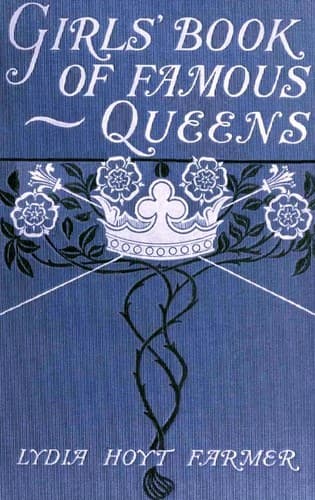
The Girls' Book of Famous QueensFarmer, Lydia Hoyt
History
The Girls' Book of Famous Queens
Farmer, Lydia Hoyt
Queens -- Biography -- Juvenile literature
When Cæsar received her letter, in which Cleopatra requested that she
might be buried by the side of Antony, his suspicions were aroused,
lest she contemplated killing herself, and he sent officers quickly to
her apartments. But when they opened the doors, they found Cleopatra
lying dead upon her bed of gold, arrayed in all her royal robes, and
one of her women already lying dead at her feet.
The other attendant, named Charmian, was arranging the diadem upon the
brow of her beloved mistress, and decking her form with flowers.
Seeing which, one of the soldiers exclaimed:—
“Is that well done, Charmian?”
“Very well,” she replied, “and meet for a princess descended from so
many noble kings.”
As she spoke these words, she, too, fell dead at her mistress’s side.
Both of these faithful slaves had probably poisoned themselves, also,
that they might die with their much-loved queen.
Cleopatra was buried in royal state by the side of Antony, according to
her request.
Cæsar, deprived of her much-desired presence in his triumphal
procession, ordered a statue of gold to be made of the famous Egyptian
queen, which was carried before his chariot in his after-triumphs.
The arm of this statue was adorned with a golden asp, signifying the
supposed cause of Cleopatra’s death.
Cleopatra died at thirty-nine years of age, having reigned twenty-two
years. Cæsar caused all the statues of Antony to be thrown down;
but those of Cleopatra were spared, as an officer who had been many
years in her service paid one thousand talents that they might not be
destroyed.
After Cleopatra’s death Egypt was reduced to a province of the Roman
Empire. The reign of the Ptolemies had continued two hundred and
ninety-three years.
Cæsario, the son of Cleopatra and Julius Cæsar, was put to death by
Octavius Cæsar; but her younger children were taken to Rome and treated
with kindness.
Thus perished the famous Cleopatra, whose marvellous attractions and
enchanting fascinations of beauty and unequalled display of pomp and
royal magnificence make parts of her story to read like the wonderful
tales of the Arabian Nights; but whose selfish ambition, treachery, and
sins shrouded her last terrible end in the impenetrable blackness of
hopeless despair.
ZENOBIA.
A.D. 260.
“She had all the royal makings of a Queen.”—SHAKESPEARE.
LIKE an enchanted island rising suddenly before the vision in
mid-ocean, so did superb Palmyra of the East burst upon the sight in
the midst of an ocean of sands, and cause the tired traveller, who had
toiled painfully across the weary wastes of the Syrian desert, to pause
spellbound and enraptured before the picture of unrivalled loveliness
which suddenly met his gaze, as he looked towards the high land and
waving groves of palm-trees which marked the site of the magnificent
Palmyra, “the Tadmor in the wilderness,” said to have been founded by
Solomon as a resting-place for caravans in the midst of the trackless
desert.
Public-domain text, read in full here on John Shaqi.
Reviews
Reviews
No reviews yet
Be the first to share your thoughts on this work.
Elsewhere in the archive
Join the Discussion
Join the discussion
Sign in to leave a comment or review.
Sign InorCreate an account