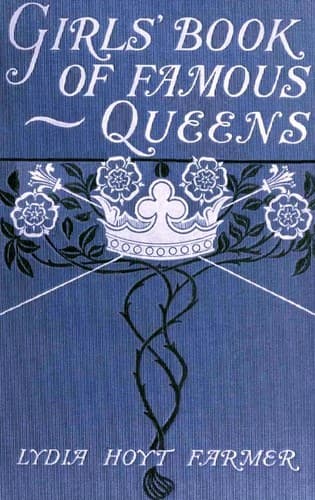
The Girls' Book of Famous QueensFarmer, Lydia Hoyt
History
The Girls' Book of Famous Queens
Farmer, Lydia Hoyt
Queens -- Biography -- Juvenile literature
from such strict confinement; and at length her impoverished father
came to her partial relief, and by sacrificing his inheritance of
Provence, he succeeded in securing her release from imprisonment, she
having signed a formal renunciation of all the rights her marriage in
England had given her.
But this poor faded Red Rose had one more trial to bear. A dry leprosy
now attacked the once beautiful Margaret of Anjou, and transformed the
lovely “Marguerite,” whose beauty had been celebrated throughout the
world, into a loathsome spectacle of horror. For nearly six years
she endured a living death in the castles provided by her father for
her retreat, until, in 1482, the welcome summons came. She was buried
in the cathedral of Angers, and her only memorial was her portrait
on glass in a window of the cathedral, which had been painted by her
father twenty years before. Maria Louisa, the second wife of Napoleon
I., possessed the breviary once owned by Margaret of Anjou: in it was
written, “_Vanite des vanites, tout la vanite!_” Surely a fitting
epitaph for the once beautiful, powerful, lovely Margaret of Anjou,
queen of England; but alas! afterwards, the fallen, faded, hapless Red
Rose of English history.
Among the warm partisans of the Lancastrian cause, was John Grey,
afterwards Lord Ferrers, whose wife was the beautiful Elizabeth
Woodville, maid of honor at the court of Queen Margaret.
Lord Ferrers lost his life in the War of the Roses; and his widow, the
beautiful Lady Grey, afterwards married Edward, son of the renowned
Duke of York, the champion of the White Rose.
By this marriage of the Roses, which occurred after Edward had become
king of England, as Edward IV., this famous War of the Roses ended in a
match of hearts.
CATHARINE OF ARAGON.
A.D. 1485-1536.
“By my troth,
I would not be a queen!
Verily,
I swear, ’tis better to be lowly born,
And range with humble livers in content,
Than to be perk’d up in a glistering grief,
And wear a golden sorrow.”—SHAKESPEARE.
BEAUTIFUL Granada rose like an enchanted city in the midst of the
blooming plain, where flourished the citron and the pomegranate, the
latter of which gave to the city its euphonious name. Olive groves
and vineyards clustered around it and fig-trees hung heavy with their
purplish fruit; while orange and lemon groves bent ’neath the rich
burden of golden spheres of luscious nectar, intermingled with the
snowy blossoms which, half hidden amongst the dark green foliage,
filled the air with such exquisite perfume as to make one dream of the
ambrosial fields of Paradise. To the north, towered mountains whose
lofty, snow-crowned summits seemed to pierce the blue heavens above,
and other ranges guarded it on the east and south, while the blue
waters of the Mediterranean washed its western shores, and brought
trade and commerce to this fair Eden of sunny Spain.
Public-domain text, read in full here on John Shaqi.
Reviews
Reviews
No reviews yet
Be the first to share your thoughts on this work.
Elsewhere in the archive
Join the Discussion
Join the discussion
Sign in to leave a comment or review.
Sign InorCreate an account