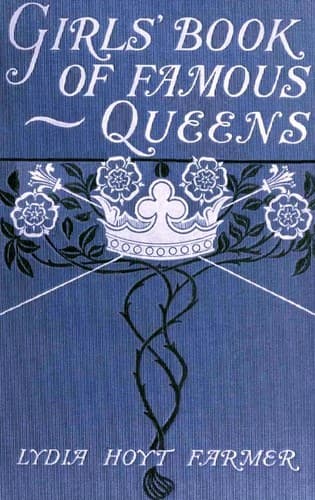
The Girls' Book of Famous QueensFarmer, Lydia Hoyt
History
The Girls' Book of Famous Queens
Farmer, Lydia Hoyt
Queens -- Biography -- Juvenile literature
It was from Granada, this fairy-land of her youthful memories, that
Catharine derived her device of the pomegranate. The pomegranate was
the royal insignia of the Moorish kings. The motto afterwards adopted
by Queen Catharine, “_Not for my crown_,” was also derived from the
same source; for the crown of the pomegranate is worthless and is
always thrown away.
What strange contrast in the two pictures portrayed in the life of
Catharine by the unforeseen vicissitudes of fortune. The blooming
maiden, filled with ecstatic pleasure by the alluring fascinations of
the matchless scenes around her, now wandering with childish curiosity
through the glowing courts of the glorious Alhambra, or enjoying the
sylvan retreats amidst the orange and citron groves, or seeking the
cool shade of the pomegranate trees, presents a very different picture
to the neglected queen of England, cruelly banished by her atrocious
husband, to die in loneliness and even penury.
When the Princess Catharine was nine years of age, she was betrothed to
Arthur, Prince of Wales, eldest son of Elizabeth of York and Henry VII.
The correspondence of these youthful lovers was carried on in Latin,
that they might improve themselves in that language.
In 1501, Catharine embarked with her Spanish governess and four young
court ladies, attended by a train of lords and ecclesiastics, to go to
England to be united in marriage to Prince Arthur. The marriage was
celebrated Nov. 14, 1501.
Catharine’s bridal costume was a great surprise to the English ladies.
The Spanish princess and her ladies had previously astonished the
English populace, when, according to an English fashion, they made
their equestrian public entry into London. The large round hats worn by
Catharine and her _donnas_ upon that occasion had created much comment.
“At her bridal Catharine wore upon her head a coif of white silk, with
a scarf bordered with gold and pearls and precious stones, five inches
and a half broad, which veiled the greater part of her visage and her
person. This was the celebrated Spanish mantilla. Her gown was very
large; both the sleeves and also the body had many plaits, and beneath
the waist certain round hoops, bearing out the gown from the waist
downward. Such was the first arrival of the farthingale in England,
revived at times as hoop petticoats and crinolines. In the elaborate
pageantry the princely pair were very prettily allegorized, she as ‘My
Lady Hesperus,’ and he as ‘The Star Arcturus,’ from which the Celtic
name of Arthur is derived.”
The old chronicles thus describe the gorgeous marriage ceremony:—
“Within the church of St. Paul’s was erected a platform or stage, six
feet high, and extending from the west door to the uppermost step of
the choir; in the middle of this platform was a high stand like a
mountain, which was ascended on every side with steps covered over with
red worsted.
Public-domain text, read in full here on John Shaqi.
Reviews
Reviews
No reviews yet
Be the first to share your thoughts on this work.
Elsewhere in the archive
Join the Discussion
Join the discussion
Sign in to leave a comment or review.
Sign InorCreate an account