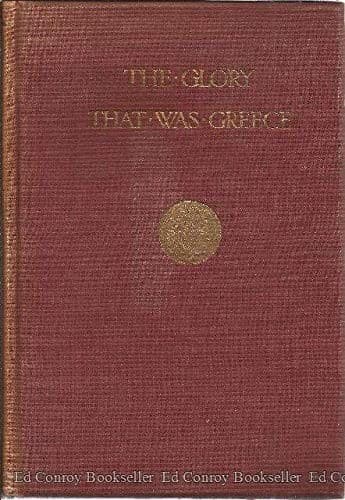
The Glory That Was Greece: a survey of Hellenic culture and civilisationStobart, J. C. (John Clarke)
History
The Glory That Was Greece: a survey of Hellenic culture and civilisation
Stobart, J. C. (John Clarke)
Art, Greek; Greece -- Civilization -- To 146 B.C.
The side of this great contest which chiefly concerns us is its effect
in promoting Athenian civilisation. Salamis and Platæa had pushed Athens
forward into the front rank of Greece, to a position almost on a level
with Sparta herself. It is true that she still had to ask Sparta’s
permission, or to trick her into acquiescence, before she could build
the walls she desired. But above all it was a triumphant vindication of
the policy of Themistocles. Even Aristeides, who had come home to help
his country in her hour of trial, had to admit that. Henceforth he seems
to be working with Themistocles on the democratic side. For Salamis had
outshone even Marathon. The “nautical rabble” had justified itself. The
party of cautious hoplites, who feared democracy, no longer controlled
the policy of the state. Instead, they remained on their devastated
farms, grumbling at the “demagogues,” and issuing forth to support
conservative politicians like Kimon and Nikias. Their great champion in
literature is Aristophanes, who loves to depict the old Marathon men as
the real bulwark of the state. When Athens was rebuilt Themistocles saw
to it that the Peiræus should henceforth be part of the city, connected
with it by long walls. The Peiræus stood for naval interests and naval
empire, for commerce (though not for peace), and for democracy. It was
not so far off but that the voters could flock up to Athens when an
Assembly was to be held. It contained a large population of resident
foreigners.
This was how Athens became a democratic city-state.
[Illustration: PLATE XXXVIII. PERICLES
_Mansell & Co._]
Democracy advanced in various stages: the poorest were made eligible for
the magistracies; the encroaching power of the Areopagus was reduced;
the magistrates (archons) and the Councillors were no longer leaders
elected for merit, but ordinary burgesses chosen by lot; the Assembly
became actually sovereign over administration within the terms of the
constitution. Themistocles himself was presently ostracised, being far
too great and clever to be a comfortable companion in a democratic
city-state. Curiously enough, time has spared one of the very “ostraka,”
or potsherds, bearing his name by which he was condemned to banishment.
[Illustration: Ostrakon of Themistocles]
Public-domain text, read in full here on John Shaqi.
Reviews
Reviews
No reviews yet
Be the first to share your thoughts on this work.
Elsewhere in the archive
Join the Discussion
Join the discussion
Sign in to leave a comment or review.
Sign InorCreate an account