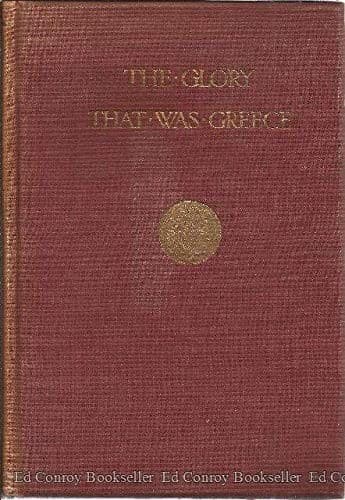
The Glory That Was Greece: a survey of Hellenic culture and civilisationStobart, J. C. (John Clarke)
History
The Glory That Was Greece: a survey of Hellenic culture and civilisation
Stobart, J. C. (John Clarke)
Art, Greek; Greece -- Civilization -- To 146 B.C.
It must not be forgotten that the themes upon which Tragedy drew were,
almost exclusively, the heroic or epic legends. One or two exceptions
there are; the “Persæ” of Æschylus is one such, for reasons which I have
already explained. Phrynichus also wrote a tragedy founded on
contemporary history, “The Sack of Miletus,” an episode of the Ionian
revolt. But such a theme came too near home, touched too closely on
politics, and the poet was punished with a fine. Otherwise the dramatist
had no scope for originality or for the element of the unexpected in the
choice of his plot. It is as if
[Illustration: PLATE LIV. THEATRE AT EPIDAURUS
_English Photo Co., Athens_]
our dramatists were restricted to the Bible for their choice of subjects
instead of being entirely debarred from it. The audience knew the main
outline of the story as soon as the play began. Thus the audience was
often in the secret while the characters on the stage were not, and this
fact gave scope for dramatic irony, which is especially connected with
the name of Sophocles.
Sophocles is for literature the supreme embodiment of the Athenian
spirit at this its purest and highest period. The tragedies of Æschylus
have the grandeur and incompleteness of archaic art. He wrestles with
the most awful problems of human destiny and divine purpose. His style
matches his themes; it is a whirlpool of foaming imagery in which great
masses of poetry in phrase and metaphor appear and disappear
continually. He continually baffles the transcriber and the modern
interpreter, and it is only the most reverential spirit that can refrain
from occasional sensations of ludicrous bathos. Euripides, on the other
hand, is so fluent and easy in his craftsmanship that he often seems by
contrast commonplace. He is probably the cleverest of all dramatists,
and he often dealt with his religious themes in the spirit of an
unabashed sceptic. Like Plato, he saw that the gods of anthropomorphic
creation were very far from ideal; and he used all the craft and
subtlety of the rationalist to exhibit them at their weakest. Æschylus
is the poet of the religious men of Marathon; Euripides, “the human,” is
the prophet of the New Age of the fourth century, liberal, cosmopolitan,
restless and fearless in inquiry. Sophocles is the true exponent of
Periclean Athens in the realm of literature.
With his inflexible idealism, the poetry of Sophocles is sublimated
almost beyond human ken. Moderns sometimes find him too perfect, too
statuesque to be interesting. It is both their misfortune and their
fault. The appreciation of Sophocles is a test of refined scholarship
and an ear sensitive to the inner voices of poetry. This makes
translation almost impossible, but Mr. Whitelaw, of Rugby, has come so
near to achieving that impossible that I would venture, through his
medium, to present a specimen of this poet’s exquisite art. This is the
famous choric ode on Love from the “Antigone.”
STROPHE
Public-domain text, read in full here on John Shaqi.
Reviews
Reviews
No reviews yet
Be the first to share your thoughts on this work.
Elsewhere in the archive
Join the Discussion
Join the discussion
Sign in to leave a comment or review.
Sign InorCreate an account