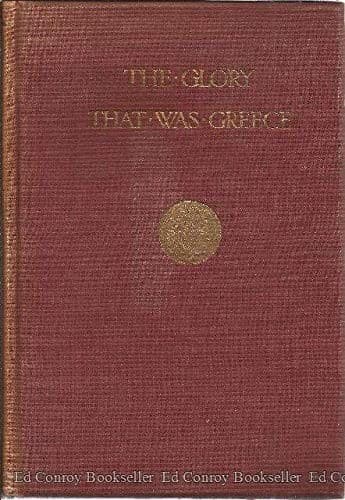
The Glory That Was Greece: a survey of Hellenic culture and civilisationStobart, J. C. (John Clarke)
History
The Glory That Was Greece: a survey of Hellenic culture and civilisation
Stobart, J. C. (John Clarke)
Art, Greek; Greece -- Civilization -- To 146 B.C.
This principle may be studied in detail upon the tombstones of Athens.
You may often get much illumination about the character of people from
their attitude in presence of death. The Turk plants cypresses in his
cemeteries, carves a turban on a shaft over his graves, and then leaves
the dead to keep their own graveyards tidy. The Frenchman adorns his
tombs with conventional wreaths of tin flowers. The Englishman
advertises the virtues of the wealthy deceased and the emotions of the
survivors in Biblical texts or rather insincere epitaphs. The Italian,
when he can afford it, erects florid monuments in Carrara marble. The
nomad barbarian burns his dead, the jungle savage leaves the corpse in a
tree for sepulture by the birds of heaven. The Egyptian preserves the
body in balms and spices for the great awakening. The Roman generally
used the pyre and stored the ashes methodically in tombs and catacombs.
We have seen that a divergence in funeral practice probably marks the
difference between the two races which went to make up the population of
ancient Greece. The aboriginal Southerners seem to have preserved their
dead in shaft-graves and dome-graves, when their means allowed,
sometimes only in earthenware jars. Rock-tombs of a similar character
are found in great numbers all over Asia Minor, especially in Phrygia
and Lycia. Sometimes in more civilised times they are replaced by large
sarcophagi of stone, wood, or earthenware. Such is the Harpy Tomb at
Xanthus, and the sculptures upon
[Illustration: PLATE LVIII. ORPHEUS AND EURYDICE. [TOMBSTONE RELIEF]
_Alinari_]
it indicate the religious beliefs which accompany that form of
burial--the winged angels which carry the soul away after death, whether
called Fates or Harpies. Then the soul itself is often represented as a
tiny winged figure, sometimes issuing from the mouth of the dead. It was
thus that the Greek word Psyche came to mean both “soul” and
“butterfly.” Tombs of this architectural character were obviously
intended as houses for the dead, and, indeed, their design often follows
the character of the houses occupied by the living. In accordance with
the same idea, objects dear to the living are buried with the dead, such
as the weapons and accoutrements of a warrior, the jewels and personal
belongings of a woman, the toys of a child. Sometimes economical motives
lead to a mere conventional copying of the real object, and many of the
axes and swords found in the old tombs are far too weak ever to have
been made for practical use. Blood and libations were sometimes poured
into the graves, and vessels containing oil, or even food and drink,
were often placed in the tomb, and when money came into use as much of
that as could conveniently be spared. That too was conventionalised into
the penny due to Charon, who ferried souls across the Styx. The “sop to
Cerberus” was also a mythological explanation of the food buried with
the body.
Public-domain text, read in full here on John Shaqi.
Reviews
Reviews
No reviews yet
Be the first to share your thoughts on this work.
Elsewhere in the archive
Join the Discussion
Join the discussion
Sign in to leave a comment or review.
Sign InorCreate an account