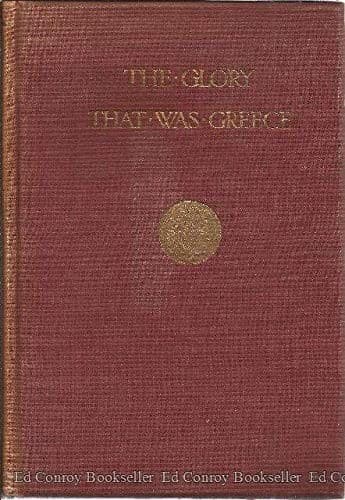
The Glory That Was Greece: a survey of Hellenic culture and civilisationStobart, J. C. (John Clarke)
History
The Glory That Was Greece: a survey of Hellenic culture and civilisation
Stobart, J. C. (John Clarke)
Art, Greek; Greece -- Civilization -- To 146 B.C.
their way, and Athens consented to try the experiment of oligarchy
“until the end of the war.” Government henceforth was to be in the hands
of a council of 400, for government by council is the prevailing feature
of oligarchy. But, like most Greek oligarchies, Athens was also to have
a sort of select Assembly, consisting of 5000 of the well-to-do
citizens. The number of 5000 seems to represent the hoplite body of the
Athenian army. Thus Athens was imitating Sparta in limiting citizen
rights to her fully equipped land warriors, and excluding the “naval
mob” who were her real strength in war. As usual in oligarchies, even
this purged Assembly seems to have been for show rather than for use.
The government was, in fact, what it is generally called, a Government
of the Four Hundred. Fortunately for human liberty the experiment was
not a success. It only lasted for three months. The Four Hundred had, it
is true, come rather late upon the stage if they were to bring the war
to a successful conclusion. But they failed to do anything useful, and
their accession to power was marked by a failure at sea and the loss of
Eubœa. Assassination, a pleasantly rare weapon in Greek politics,
removed the leader of the oligarchs, and Athens reverted to democracy.
Once more, however, at the very end of the war, when the city
surrendered, Athens had perforce, at the bidding of
[Illustration: PLATE LXII. GIRL’S HEAD
_Eruckmann_]
Lysander, her conqueror, to revise her constitution in an oligarchic
direction. Once more the sacred laws were thrown into the melting-pot,
and there were elaborate programmes, and discussions as to the precise
form of oligarchy which should be adopted. But while the preliminaries
were going on the administration fell into the hands of a board of
so-called commissioners charged, like Oliver Cromwell, with the revision
of the constitution. Like Oliver these men soon found themselves in a
position of power too good to be lost. They were called the Thirty
Tyrants, and they deserved the name. They ruled with a strong hand,
banished their enemies, disarmed the citizen army, and began a system of
private plunder, with the spears of the Spartan garrison to enforce
their commands. Athens never forgot and never forgave this nightmare of
the Thirty. Most of them were men of talent, some of them were
philosophers and literary men who had sat at the feet of Socrates.
Critias, the Robespierre of the party, quarrelled with Theramenes, its
philosophical Danton, an advocate of the “moderate Constitution,” and
sent him to execution. Before very long, one is glad to know, honest men
(by which term one means, in this instance, democrats) were gathering on
the borders of Attica, and under the leadership of Thrasybulus won their
way home and crushed the “gentle Critias” and his gang for ever.
Public-domain text, read in full here on John Shaqi.
Reviews
Reviews
No reviews yet
Be the first to share your thoughts on this work.
Elsewhere in the archive
Join the Discussion
Join the discussion
Sign in to leave a comment or review.
Sign InorCreate an account