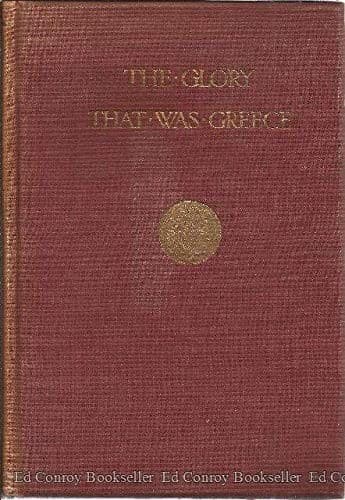
The Glory That Was Greece: a survey of Hellenic culture and civilisationStobart, J. C. (John Clarke)
History
The Glory That Was Greece: a survey of Hellenic culture and civilisation
Stobart, J. C. (John Clarke)
Art, Greek; Greece -- Civilization -- To 146 B.C.
always been a rhetorical people. We have noted how, even in Homer,
persuasion by the power of speech was a god-given attribute of kings and
elders. The Greeks, and the Romans too, went into battle under the
influence of oratory as our Highlanders are aroused to martial frenzy by
the eloquence of the pibroch. No one doubts that all the speeches in
Thucydides’ history are of his own invention, but if they bear any
resemblance to the real thing we must believe that the Greek soldier was
encouraged, in the fifth century, to fight by a very sober and logical
style of speech, including a categorical estimate of the chances in his
favour. The modern reader is frequently lulled to sleep by the words of
Brasidas or Nikias encouraging his men to battle. Thucydides had, it
seems, learnt his peculiarly artificial style of rhetoric from Antiphon,
who was the first professional rhetorician to engage in politics. But
even Antiphon was content to direct operations through his pupils. In
the fourth century the trained professional orator comes forward on the
Pnyx as a public statesman, is elected general, and gives orders to the
professional soldiers who now command armies and fleets. The profession
of the pleader had grown inevitably out of the legal system in vogue at
Athens. Where suits were decided by juries numbering hundreds, a rather
violent style of pleading had naturally arisen. Although it was
necessary by law for the litigants to conduct their own case, it became
customary for them to apply to speech-writers like Lysias, Isæus, and
Demosthenes for a speech to be learnt and recited as dramatically as
possible. We should expect such performances to be highly emotional and
to consist largely of oratorical claptrap. That, on the contrary, they
are for the most part severely logical, that purple passages are
carefully eschewed and references to national feeling kept within limits
is the clearest possible proof of the high intellectual standard of the
average Athenian citizen who sat upon the jury. It is true that
defendants did dress in mourning and produce wives and families in rags
and tears to move the sympathies of their judges, but their arguments
must be sensible and must include copious reference to the letter of
the law. From the so-called “Private Orations” of Demosthenes we obtain
rare glimpses of social life at Athens in the fourth century, the banker
Phormio who rises to affluence from slavery, who is liberated and
marries his master’s daughter, the elegant hooliganism of rich young men
who quarrel in camp and assault one another in the Athenian
market-place, the extraordinary luxury of Meidias, who rode on a
silver-plated saddle, or the quarrels of neighbours in the country about
watercourses and rights of way. In a later chapter we shall have to
consider the public orations of Demosthenes as the opponent of the
Macedonian conquerors. He is unquestionably for European literature the
father of oratory.
Public-domain text, read in full here on John Shaqi.
Reviews
Reviews
No reviews yet
Be the first to share your thoughts on this work.
Elsewhere in the archive
Join the Discussion
Join the discussion
Sign in to leave a comment or review.
Sign InorCreate an account