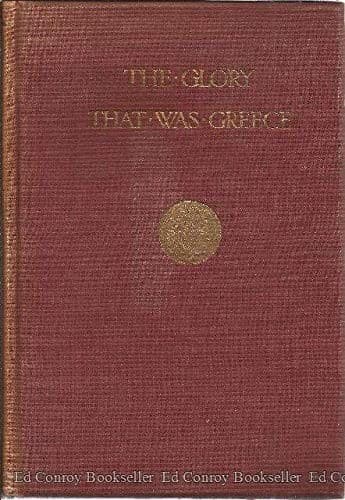
The Glory That Was Greece: a survey of Hellenic culture and civilisationStobart, J. C. (John Clarke)
History
The Glory That Was Greece: a survey of Hellenic culture and civilisation
Stobart, J. C. (John Clarke)
Art, Greek; Greece -- Civilization -- To 146 B.C.
Ideal Republic. Before they have gone very far it is evident, and indeed
it is admitted, that such a state as they envisage cannot exist upon
earth, though it may be laid up in the heavens for an example. It is a
small Greek city-state. Plato discerns three elements in every state,
the producers, the warriors, and the thinking element. Of these he makes
three rigid classes, though education, upon the importance of which
Plato everywhere insists, is to provide the means of rising for all.
Music and gymnastics are the twofold base of Platonic education. The
thinking part of the community are to have the sole title to government.
They are to live a simple communistic life, rather like the nobles of
Sparta, but without their military activity. In order that nothing may
disturb their absolute unity, Plato decrees that wives and children are
to be held in common, as well as all property. These strange doctrines
have caused Plato to be held as the father of Socialism, but it is to be
observed that in Plato communism is only advocated for a restricted
circle of aristocrats, and that it is based not upon economic
considerations, but on ethics in a spirit of asceticism. In a later
dialogue Plato regretfully admits that laws are necessary to a state,
seeing that you cannot keep your philosophers on the throne when you
have got them there. This admission may be occasioned by the failure of
Plato to realise his ideals in actual practice. He had an extraordinary
chance. He was invited over to Syracuse to mould the character and
policy of the young tyrant Dionysius II. He argued that it was useless
to place an ideal system of government before a young man who was not of
sufficient education to appreciate it. He therefore determined to begin
with the education of the prince, and began it with geometry. The issue
may be easily guessed.
Public-domain text, read in full here on John Shaqi.
Reviews
Reviews
No reviews yet
Be the first to share your thoughts on this work.
Elsewhere in the archive
Join the Discussion
Join the discussion
Sign in to leave a comment or review.
Sign InorCreate an account