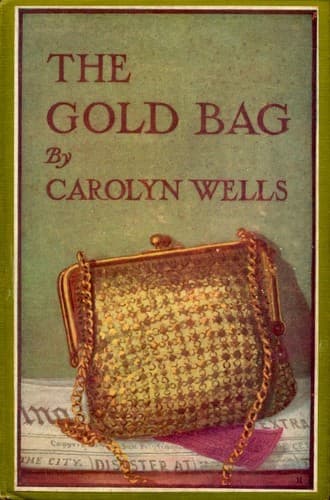
Detective and mystery stories; Stone, Fleming (Fictitious character) -- Fiction
“Those Marathon Park people? Oh, yes. They were a gay party,--coming
back from a theatre supper, I suppose. And that reminds me: Philip
Crawford sat right behind the Cunninghams. I forgot him before. Well, I
guess that's all the West Sedgwick people I can remember.”
I went away not much the wiser, but with a growing thought that buzzed
in my brain.
It was absurd, of course. But he had said Philip Crawford had sat right
behind Mrs. Cunningham. How, then, could he help seeing the gold bag she
left behind, when she got out at the station just before West Sedgwick?
Indeed, who else could have seen it but the man in the seat directly
behind? Even if some one else had picked it up and carried it from the
car, Mr. Crawford must have seen it.
Moreover, why hadn't he said he was on that train? Why conceal such a
simple matter? Again, who had profited by the whole affair? And why had
Gregory Hall said: “Ask the conductor who did get off that train?”
The rose petals were already explained by Florence. If, then, Philip
Crawford had, much later, come to his brother's with the gold bag and
the late newspaper, and had gone away and left them there, and had never
told of all this, was there not a new direction in which to look?
But Philip Crawford! The dead man's own brother!
XIX. THE MIDNIGHT TRAIN
The enormity of suspecting Philip Crawford was so great, to my mind,
that I went at once to the district attorney's office for consultation
with him.
Mr. Goodrich listened to what I had to say, and then, when I waited for
comment, said quietly:
“Do you know, Mr. Burroughs, I have thought all along that Philip
Crawford was concealing something, but I didn't think, and don't think
now, that he has any guilty secret of his own. I rather fancied he
might know something that, if told, would be detrimental to Miss Lloyd's
cause.”
“It may be so,” I returned, “but I can't see how that would make him
conceal the fact of his having been on that late train Tuesday night.
Why, I discussed with him the possibility of Hall's coming out on it,
and it would have been only natural to say he was on it, and didn't see
Hall.”
“Unless he did see him,” remarked the district attorney.
“Yes; there's that possibility. He may be shielding Hall for Miss
Lloyd's sake--and--”
“Let's go to see him,” suggested Mr. Goodrich. “I believe in the
immediate following up of any idea we may have.”
It was about five in the afternoon, an hour when we were likely to find
Mr. Crawford at home, so we started off at once, and on reaching his
house we were told that Mr. Randolph was with him in the library, but
that he would see us. So to the library we went, and found Mr. Crawford
and his lawyer hard at work on the papers of the Joseph Crawford estate.
Perhaps it was imagination, but I thought I detected a look of
apprehension on Philip Crawford's face, as we entered, but he greeted us
in his pleasant, simple way, and asked us to be seated.
Public-domain text, read in full here on John Shaqi.
Reviews
Reviews
No reviews yet
Be the first to share your thoughts on this work.
Elsewhere in the archive
Join the Discussion
Join the discussion
Sign in to leave a comment or review.
Sign InorCreate an account