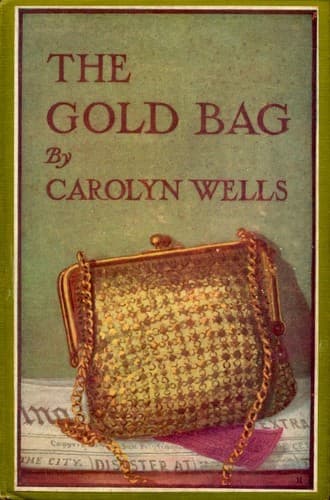
Detective and mystery stories; Stone, Fleming (Fictitious character) -- Fiction
“Do you know a Mrs. Egerton Purvis?”
I flung the question at him, suddenly, hoping to catch him unawares. But
he only looked at me with the blank expression of one who hears a name
for the first time.
“No,” he answered, “I never heard of her. Who is she?”
“Well, when I was hunting through that gold-mesh bag, I discovered a
lady's visiting card with that name on it. It had slipped between the
linings, and so had not been noticed before.”
To my surprise, this piece of information seemed to annoy Mr. Crawford
greatly.
“No!” he exclaimed. “In the bag? Then some one has put it there! for I
looked over all the bag's contents myself.”
“It was between the pocket and the lining,” said I; “it is there still,
for as I felt sure no one else would discover it, I left it there. Mr.
Goodrich has the bag.”
“Oh, I don't want to see it,” he exclaimed angrily. “And I tell you
anyway, Mr. Burroughs, that bag is worthless as a clue. Take my advice,
and pay no further attention to it.”
I couldn't understand Mr. Crawford's decided attitude against the bag as
a clue, but I dropped the subject, for I didn't wish to tell him I had
made plans to trace up that visiting card.
“It is difficult to find anything that is a real clue,” I said.
“Yes, indeed. The whole affair is mysterious, and, for my part, I
cannot form even a conjecture as to who the villain might have been. He
certainly left no trace.”
“Where is the revolver?” I said, picturing the scene in imagination.
Philip Crawford started as if caught unawares.
“How do I know?” he cried, almost angrily. “I tell you, I have no
suspicions. I wish I had! I desire, above all things, to bring my
brother's murderer to justice. But I don't know where to look. If the
weapon were not missing, I should think it a suicide.”
“The doctor declares it could not have been suicide, even if the weapon
had been found near him. This they learned from the position of his arms
and head.”
“Yes, yes; I know it. It was, without doubt, murder. But who--who would
have a motive?”
“They say,” I observed, “motives for murder are usually love, revenge,
or money.”
“There is no question of love or revenge in this instance. And as for
money, as I am the one who has profited financially, suspicion should
rest on me.”
“Absurd!” I said.
“Yes, it is absurd,” he went on, “for had I desired Joseph's fortune,
I need not have killed him to acquire it. He told me the day before
he died that he intended to disinherit Florence, and make me his heir,
unless she broke with that secretary of his. I tried to dissuade him
from this step, for we are not a mercenary lot, we Crawfords, and I
thought I had made him reconsider his decision. Now, as it turns out, he
persisted in his resolve, and was only prevented from carrying it out by
this midnight assassin. We must find that villain, Mr. Burroughs! Do not
consider expense; do anything you can to track him down.”
Public-domain text, read in full here on John Shaqi.
Reviews
Reviews
No reviews yet
Be the first to share your thoughts on this work.
Elsewhere in the archive
Join the Discussion
Join the discussion
Sign in to leave a comment or review.
Sign InorCreate an account