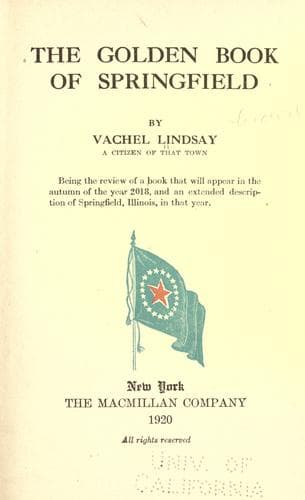
Springfield (Ill.) -- Fiction; Springfield (Ill.) -- In literature; Utopias in literature
Boone continues, in an utterly different manner. There is that curious
slender girl near the front seat with her companions, the Lady Avanel,
and he does not want to seem to be speaking of her. But he says that
these Singaporians are as afraid of white as the native soldiers of the
Indian mutiny were afraid of breaking caste in their fashion, or the
Egyptians were,—which enabled Cambyses to defeat them by heading his
procession against them with a small and famous army of kittens. He says
they are as afraid of white as the negroes of the South were afraid of
it, which enabled the Ku Klux to send them scattering. It is no idle
fancy of his that these people are as superstitious as the blacks of the
old days. He says that in the last war of the World Government against
the rebels of Asia, where Chinese, Japanese and Americans won so great a
victory for world unity, there were a few Singaporians among the rebels,
denounced by the Singaporian high priests, but these rebels seemed
secretly authorized, and they had the typical lens gun equipment and the
complete cocaine soul. And Boone tells what is evidently a familiar
story, how one of the Springfield Amazons found a mysterious white pony
on the battlefield, after her own had been shot under her. She rode him
to the front line and drove a whole company of those cocaine fiends in
flight, lens guns and all, with nothing in her hand but her Michael-forged
blade. Boone says the Singaporians hate white because it is the
color of truth and daytime and decency, and as for him, if he had had
his way he would have painted every tower of this World’s Fair white,
and the inner and outer walls of the city white, to keep out the
Singaporian spies and missionaries, but Slick Slack Kopensky and Mayo
Sims won a victory for the present color scheme.
Then young Joseph Bartholdi Michael, the Third, to keep himself right
with his friends, throws off his coat, and goes forward in the
bricklayer’s clothes he has been wearing beneath. As a former High
School student-bricklayer and one often practicing that profession
still, he pledges himself to go out and work one of the bricklaying
machines, or use the old fashioned trowel, as is needed, until the Fair
buildings are done. And he calls for volunteers to join him, and many of
the gay young bloods do so at once.
So this evening as I serve the black Siamese wine to the Man from
Singapore and his daughter, and I stand respectfully at her left hand,
and give my report while her wonderful smiles come and go, she clasps
her hands and tries to be gay over old Boone. But her eyes are tragic
pools, indeed, when I speak of her lover, and of the evident conflict in
his heart. And now it is her father’s turn to laugh and try to shift her
mood.
Public-domain text, read in full here on John Shaqi.
Reviews
Reviews
No reviews yet
Be the first to share your thoughts on this work.
Elsewhere in the archive
Join the Discussion
Join the discussion
Sign in to leave a comment or review.
Sign InorCreate an account