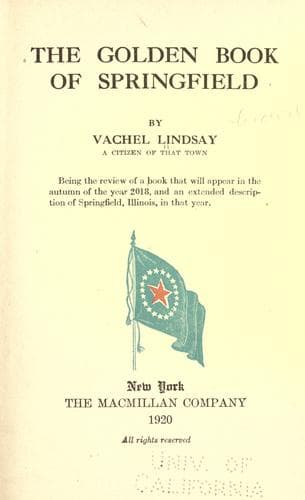
Springfield (Ill.) -- Fiction; Springfield (Ill.) -- In literature; Utopias in literature
Old Montague Rock has always had an irritating style of address and he
has made a speech to the strikers in a fashion that has not helped
toward peace one little bit. He has said this very morning that the
Singaporians are the souls of honor and most admirable, aside from their
religion, with which, of course, he has nothing to do. And that they are
the height of Asiatic aristocracy at all times. He has said our city
should be flattered to furnish them with lenses for guns for local
police work in Asia. And so he continues to paraphrase his speech in
conversations with reporters at Fifth and Monroe and in Coe’s Book
Store, and wherever he meets his friends and enemies, through the whole
afternoon.
So _The Boone Ax_ advocates a strikers’ parade for tomorrow afternoon
and Boone strains his whole credit and prestige in the city to make it a
success. Those societies, etc. that are to be the principal decorative
features are listed, in this afternoon’s papers, and the line of march
is printed. They are to assemble on Second and Monroe, near the old
arsenal, and march south on Second to Capital Avenue, east on Capital
Avenue to Fifth, north on Fifth to Monroe, east on Monroe to Sixth, etc.
May 31:—The Anti King Coal Parade goes by this afternoon with many
surprises, not in the official list of splendors. The event was
scheduled to be called: “The Parade of the Striking Lens Factory” but
Montague Rock being often called King Coal, the other title gets into
the headlines.
First, between girls on horseback, carrying the Star Spangled Banner and
the International flag, rides Patricia Anthony, forewoman of the lens
factory, and, after her, march or ride the strikers, in all possible
glittering and glassy spangles, to show their trade and their gaiety.
And then comes King Coal in chains. He is presumed to be an excellent
portrait of the head of the Rock family. He is built of actual coal, in
parts, and black pasteboard also. Elegant minions of King Coal are
impersonated by masked people, in caricatures of the fastidious
Singaporian costume, and they wear light chains that, nevertheless, hold
them in leash to the great image.
Everyone jeers with emphasis when King Coal goes by, and many people on
the street sing and shout:—“The Song for All Strikers” composed by
Portia, the Singing Aviator, for this especial parade.
Public-domain text, read in full here on John Shaqi.
Reviews
Reviews
No reviews yet
Be the first to share your thoughts on this work.
Elsewhere in the archive
Join the Discussion
Join the discussion
Sign in to leave a comment or review.
Sign InorCreate an account