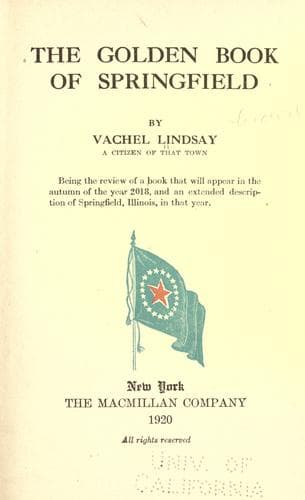
Springfield (Ill.) -- Fiction; Springfield (Ill.) -- In literature; Utopias in literature
The real name of our saint, which no one ever hears, is Hugh Adams
Matheney. He is, away and beyond, the oldest of the Board of Education
or of any of the leaders of the city. He has little fire in his blood,
but has still the greatest reserve battery of nervous force. He was,
even as a little boy, a protege and disciple of St. Scribe of the
Shrines, who was then in the height of his glory as a leader of our
town. He preceded St. Friend as the dominating figure of the Cathedral
of St. Peter and St. Paul and handed down to him and to the whole city
the old doctrine, with a new emphasis, that the whole human race is the
mystical body of Christ, soon to be raised from the dead. On his
mother’s side St. Friend is a descendant of a long line of members of
the Church of the Disciples. On his father’s side his ancestors are
notable in several lines, for instance, the Matheneys of Springfield.
The original Matheneys put up one of the first three settlers’ log
cabins ever erected in this county. The Adams strain is from New
Harmony, Indiana. There they were bakers for several generations. The
cottage of St. Friend has his baker’s coat of arms painted over the
little front door, over the tremendous open fireplace, and in the little
dining room. On one slender pole, in front of his cottage, all of his
family flags are flying. The most important of the flags, in the
estimation of St. Friend, is that of the clan of these same Adams people
from New Harmony.
St. Friend is the last of his actual clan to be a baker, though the town
is full of his first and second cousins;—and third cousins, indeed, that
claim him proudly. He has adopted a son, an orphan boy, early
apprenticed to his flour barrels by the school authorities, a boy of
Thibetan ancestry and one of a small local group of Thibetans. He is now
grown. Except for ceremonial occasions he has long graduated from
baking. He is occupied in designing more exquisite and slender sunset
towers, of the school of Louis H. Sullivan and Frank Lloyd Wright, to
add one more circle to the outer ring, when purple cottages and old
buildings have been sufficiently cleared away. He is known as the “young
St. Friend” or the “Thibetan boy.”
When I have passed him on the street, I have observed him muttering to
himself or occasionally walking and arguing with the other Thibetans. He
looks every inch the stranger, with square face and almond eyes, and
skin brickdust red, with heavy bronze beneath it.
The sister of St. Friend, living in the same cottage, a mild, ghostly
creature, creeping about, is more than a centenarian. She remembers the
celebration of Armistice Day, November 11, 1918. She was then a baby in
her father’s arms, and held out her hands to catch the falling showers
of confetti thrown from the high buildings. She thought it was snow.
Public-domain text, read in full here on John Shaqi.
Reviews
Reviews
No reviews yet
Be the first to share your thoughts on this work.
Elsewhere in the archive
Join the Discussion
Join the discussion
Sign in to leave a comment or review.
Sign InorCreate an account