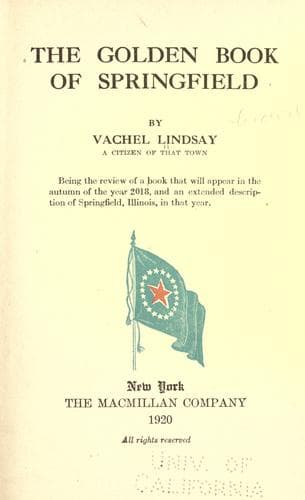
Springfield (Ill.) -- Fiction; Springfield (Ill.) -- In literature; Utopias in literature
For a long time back truly aesthetic and truly educational motion
pictures have been shown in the school and University class rooms. Many
of them are scientific and historical records and renderings. In the odd
hours of loafing through these three months I have noted many of them as
of the best gifts of the new time. But our stubborn St. Friend, as a
member of the school board, generally votes against them, and in
solitary grandeur. While at one with the general policies of the
educational system, he makes many a speech before the members for the
restoration of the regime of the book and the blackboard. He truly says
that these are now almost abolished in the presence of the protean
triumphant films, of the street pageantry, the training of skilled labor
in the high schools, of the oral, the phonographic, telegraphic and
telephone methods, applied to all forms of teaching. And only last week
he met what appeared to be his Waterloo when it was voted to extend and
enlarge the entirely respectable, if a little frigid, university dance
halls and to include motion picture loafing rooms, the better to run
competition with the Yellow Halls.
Some of these things I go over with Avanel, as we walk home from
witnessing Surto Hurdenburg’s oath, and we wonder just what of the
forbidden things, besides motion pictures, St. Friend will include in
his pledge for the Liberal Observance. Avanel says: “I admit that the
men who are sworn in, like this Surto Hurdenburg, are apt to become
useful, if fanatical, citizens. Their poor strength must be economized
in narrow channels if it is to last and be recuperated. But if St.
Friend tries to put such a set of chains on me I will not speak to him
for a month.”
Saturday, June 7:—St. Friend has today given it out by word of mouth and
by editorials in the five papers that the whole world is welcome to his
bread. The Order of the Liberal Observance is already more popularly
called by the alternate descriptive title: “The Citizens in the
Communion of the Blessed Bread.” There is no oath; even a Quaker may
join.
Sunday, June 8:—It is the warmest morning of the year, so far, in an
exceedingly backward summer. It is the first real June weather, and all
the people rejoice in it. Avanel walks to church in the most wonderful
of white airy dresses. And in these vacuum-cleaned streets, with no soot
and no coal dust and no factory grime, people, working or playing, can
be dressed all day as for a party if they choose.
All day yesterday couriers of all faiths, representing St. Friend’s
personal rather than his religious companions, have been out inviting
the people. At least one member of each family has been asked to bring
his tribe to the Cathedral green and to listen and carry the message
back with the bread.
Public-domain text, read in full here on John Shaqi.
Reviews
Reviews
No reviews yet
Be the first to share your thoughts on this work.
Elsewhere in the archive
Join the Discussion
Join the discussion
Sign in to leave a comment or review.
Sign InorCreate an account