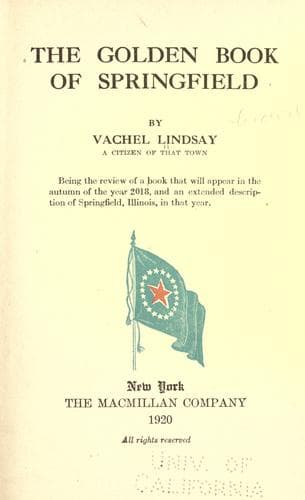
Springfield (Ill.) -- Fiction; Springfield (Ill.) -- In literature; Utopias in literature
under him do not care what his views may be on any subject but art. He
is the best teacher and that is enough for them. And, as a matter of
fact, in expressing his international views which he does out of
teaching hours, he is a roaring baby and unworthy of the attention of
grown up politicians. But I tell him that even grown ups in politics
should not be too much censured for misunderstanding him. People, like
Short, who fight for individuality and whose whole object as teachers is
to promote the diversity of their pupils, cannot see why the world
cannot be one great art class. They are, indeed, in strong contrast with
state builders, who build with men in masses and blocks.
This morning Short takes me around to the Hall of Velaska, when it is
absolutely deserted except by ourselves, and shows me with pride the
pictures he has given the hall. These pictures are so set in the walls,
they seem painted there, and the whole color scheme that Short has long
planned holds them together. There is a defiant touch of Singaporian
green in it, sometimes with the glisten of the hated green glass, but
the place is otherwise in the most quiet and inoffensive taste.
The first picture is the one that he had long planned for the World’s
Fair, till it was debarred on account of its subject:—the portrait of
_Mara of Singapore_, when she was the age of Juliet. Next is what Short
calls a Fairy Fashion-plate, a gown to be worn at the funeral of an
exceedingly wealthy bumblebee. If we are to believe our guide, Mr.
Short, here is depicted an occasion when one must wear a look of grief
and resignation and an appropriate costume. Short explains that all
bootlicking fairies consider it good form to blacken the face on such
occasions. They will not blacken their faces for bumblebees who are
poor. But, when a deal of honey is left to sustain the mourners, it has
become a convenient manner of expressing grief for the honeyeater to
steal an ink bottle off a writing table and spill the ink all over one’s
self. One looks more crestfallen than in any conventional black. So this
fairy manikin is dressed in gray dove’s feathers and ink poured on her
in streaks and her little face is all smudged with it. Soon she will
hurry home, take a complete bath, and eat the honey.
The Boy and the Ostrichissimus:—The Ostrichissimus is a bird about three
times the size of the ostrich and with ostrich plumes all over it, and
some of them so long behind, it has not the insulting shape of the
ostrich. A more graceful neck helps also. Its head is not so bald. The
Ostrichissimus is driven with a silk cord, passed through the mouth, for
a bridle. The boy driving holds on tight with both knees and is a little
scared but enjoying himself immensely. They are hurrying across the
Sahara desert.
Public-domain text, read in full here on John Shaqi.
Reviews
Reviews
No reviews yet
Be the first to share your thoughts on this work.
Elsewhere in the archive
Join the Discussion
Join the discussion
Sign in to leave a comment or review.
Sign InorCreate an account