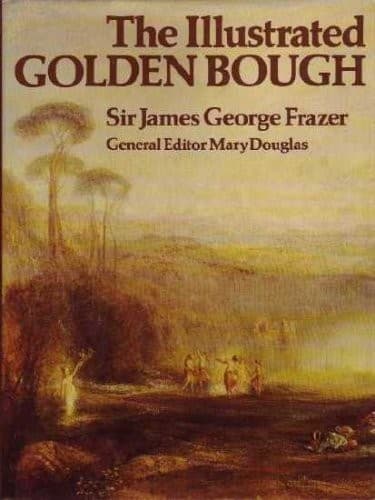
The Golden Bough: A Study in Comparative Religion (Vol. 2 of 2)Frazer, James George
ReligionComparative
The Golden Bough: A Study in Comparative Religion (Vol. 2 of 2)
Frazer, James George
Magic; Mythology; Religion; Superstition
These facts by themselves would suffice to raise a strong presumption
that, if the Druids cut the mistletoe in June, as we learn from Pliny that
they did, the day on which they cut it could have been no other than
Midsummer Eve or Midsummer Day. This presumption is converted into
practical certainty when we find it to be still a rule of folk-lore that
the mistletoe should be cut on Midsummer Eve.(776) Further, the peasants
of Piedmont and Lombardy still go out on Midsummer morning to search the
oak-leaves for the “oil of St. John,” which is supposed to heal all wounds
made with cutting instruments.(777) Originally no doubt the “oil of St.
John” was simply the mistletoe, or a decoction made from it. For in
Holstein the mistletoe, especially oak-mistletoe, is still regarded as a
panacea for green wounds;(778) and if, as is alleged, “all-healer” is an
epithet of the mistletoe in the modern Celtic speech of Britanny, Wales,
Ireland, and Scotland,(779) this can be nothing but a survival of the name
by which, as we have seen, the Druids addressed the oak, or rather,
perhaps, the mistletoe.
Thus it appears that the two main features of the Balder myth—the pulling
of the mistletoe and the burning of the god—were reproduced in the great
midsummer festival of the Celts. But in Scandinavia itself, the home of
Balder, both these features of his myth can still be traced in the popular
celebration of midsummer. For in Sweden on Midsummer Eve mistletoe is
“diligently sought after, they believing it to be, in a high degree,
possessed of mystic qualities; and that if a sprig of it be attached to
the ceiling of the dwelling-house, the horse’s stall, or the cow’s crib,
the ‘Troll’ will then be powerless to injure either man or beast.”(780)
And in Sweden, Norway, and Denmark huge bonfires are kindled on hills and
eminences on Midsummer Eve.(781) It does not appear, indeed, that any
effigy is burned in these bonfires; but the burning of an effigy is a
feature which might easily drop out after its meaning was forgotten. And
the name of Balder’s bale-fires (_Balder’s Bălar_), by which these
midsummer fires were formerly known in Sweden,(782) puts their connection
with Balder beyond the reach of doubt, and makes it certain that in former
times either a living representative or an effigy of Balder must have been
annually burned in them. Midsummer was the season sacred to Balder, and
the fact that the Swedish poet Tegner, in his _Frithiofssaga_, places the
burning of Balder at midsummer(783) may perhaps be allowed as evidence of
a Swedish tradition to that effect. From this double coincidence of the
Balder myth, on the one hand with the midsummer festival of Celtic Gaul
and on the other with the midsummer festival in Scandinavia, we may safely
conclude that the myth is not a myth pure and simple, that is, a mere
description of physical phenomena in imagery borrowed from human life; it
must undoubtedly be a ritualistic myth, that is a myth based on actual
Public-domain text, read in full here on John Shaqi.
Reviews
Reviews
No reviews yet
Be the first to share your thoughts on this work.
Elsewhere in the archive
Join the Discussion
Join the discussion
Sign in to leave a comment or review.
Sign InorCreate an account