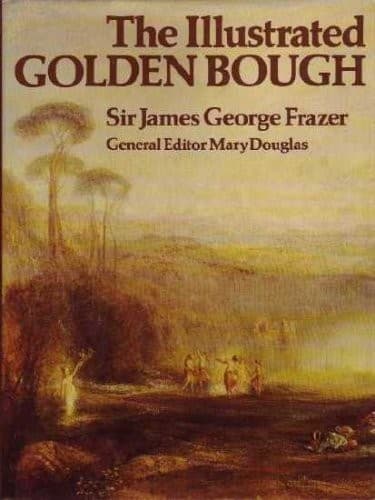
The Golden Bough: A Study in Comparative Religion (Vol. 2 of 2)Frazer, James George
ReligionComparative
The Golden Bough: A Study in Comparative Religion (Vol. 2 of 2)
Frazer, James George
Magic; Mythology; Religion; Superstition
In a Mongolian story the hero Joro gets the better of his enemy the lama
Tschoridong in the following way. The lama, who is an enchanter, sends out
his soul in the form of a wasp to sting Joro’s eyes. But Joro catches the
wasp in his hand, and by alternately shutting and opening his hand he
causes the lama alternately to lose and recover consciousness.(853) In a
Tartar poem two youths cut open the body of an old witch and tear out her
bowels, but all to no purpose, she still lives. On being asked where her
soul is, she answers that it is in the middle of her shoe-sole in the form
of a seven-headed speckled snake. So one of the youths slices her
shoe-sole with his sword, takes out the speckled snake, and cuts off its
seven heads. Then the witch dies.(854) Another Tartar poem describes how
the hero Kartaga grappled with the Swan-woman. Long they wrestled. Moons
waxed and waned and still they wrestled; years came and went, and still
the struggle went on. But the piebald horse and the black horse knew that
the Swan-woman’s soul was not in her. Under the black earth flow nine
seas; where the seas meet and form one, the sea comes to the surface of
the earth. At the mouth of the nine seas rises a rock of copper; it rises
to the surface of the ground, it rises up between heaven and earth, this
rock of copper. At the foot of the copper rock is a black chest, in the
black chest is a golden casket, and in the golden casket is the soul of
the Swan-woman. Seven little birds are the soul of the Swan-woman; if the
birds are killed the Swan-woman will die straightway. So the horses ran to
the foot of the copper rock, opened the black chest, and brought back the
golden casket. Then the piebald horse turned himself into a bald-headed
man, opened the golden casket, and cut off the heads of the seven birds.
So the Swan-woman died.(855) In a Tartar story a chief called Tash Kan is
asked where his soul is. He answers that there are seven great poplars,
and under the poplars a golden well; seven _Maralen_ (?) come to drink the
water of the well, and the belly of one of them trails on the ground; in
this _Maral_ is a golden box, in the golden box is a silver box, in the
silver box are seven quails, the head of one of the quails is golden and
its tail silver; that quail is Tash Kan’s soul. The hero of the story gets
possession of the seven quails and wrings the necks of six of them. Then
Tash Kan comes running and begs the hero to let his soul go free. But the
hero wrings the quail’s neck, and Tash Kan drops dead.(856) In another
Tartar poem the hero, pursuing his sister who has driven away his cattle,
is warned to desist from the pursuit because his sister has carried away
his soul in a golden sword and a golden arrow, and if he pursues her she
will kill him by throwing the golden sword or shooting the golden arrow at
him.(857)
Public-domain text, read in full here on John Shaqi.
Reviews
Reviews
No reviews yet
Be the first to share your thoughts on this work.
Elsewhere in the archive
Join the Discussion
Join the discussion
Sign in to leave a comment or review.
Sign InorCreate an account