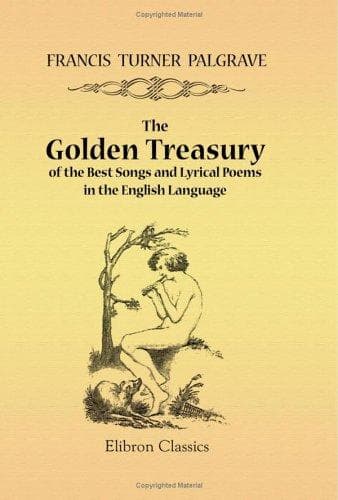
The Golden Treasury: Of the Best Songs and Lyrical Poems in the English Language
General
The Golden Treasury: Of the Best Songs and Lyrical Poems in the English Language
English poetry; Songs, English -- Texts
And O, ye Fountains, Meadows, Hills, and Groves,
Forebode not any severing of our loves!
Yet in my heart of hearts I feel your might;
I only have relinquish'd one delight
To live beneath your more habitual sway;
I love the brooks which down their channels fret
Even more than when I tripp'd lightly as they;
The innocent brightness of a new-born day
Is lovely yet;
The clouds that gather round the setting sun
Do take a sober colouring from an eye
That hath kept watch o'er man's mortality;
Another race hath been, and other palms are won.
Thanks to the human heart by which we live,
Thanks to its tenderness, its joys, and fears,
To me the meanest flower that blows can give
Thoughts that do often lie too deep for tears.
W. WORDSWORTH.
288.
Music, when soft voices die,
Vibrates in the memory--
Odours, when sweet violets sicken,
Live within the sense they quicken.
Rose leaves, when the rose is dead,
Are heap'd for the beloved's bed;
And so thy thoughts, when Thou art gone,
Love itself shall slumber on.
P.B. SHELLEY.
PALGRAVE'S NOTES.
Poem 2.
_Rouse Memnon's mother_: Awaken the Dawn from the dark Earth and the
clouds where she is resting. Aurora in the old mythology is mother of
Memnon (the East), and wife of Tithonus (the appearances of Earth and
Sky during the last hours of Night). She leaves him every morning in
renewed youth, to prepare the way for Phoebus (the Sun), whilst Tithonus
remains in perpetual old age and grayness.
_by Peneus' streams_: Phoebus loved the Nymph Daphne whom he met by the
river Peneus in the vale of Tempe. This legend expressed the attachment
of the Laurel (Daphne) to the Sun, under whose heat the tree both fades
and flourishes. It has been thought worth while to explain these
allusions, because they illustrate the character of the Grecian
Mythology, which arose in the Personification of natural phenomena, and
was totally free from those debasing and ludicrous ideas with which,
through Roman and later misunderstanding or perversion, it has been
associated.
_Amphion's lyre_: He was said to have built the walls of Thebes to the
sound of his music.
_Night like a drunkard reels_: Compare Romeo and Juliet, Act II. Scene
3: "The gray-eyed morn smiles," etc.--It should be added that three
lines, which appeared hopelessly misprinted, have been omitted in this
Poem.
Poem 4.
_Time's chest_: in which he is figuratively supposed to lay up past
treasures. So in Troilus, Act III. Scene 3, "Time hath a wallet at his
back," etc.
Poem 5.
A fine example of the high-wrought and conventional Elizabethan
Pastoralism, which it would be ludicrous to criticise on the ground of
the unshepherdlike or unreal character of some images suggested. Stanza
6 was probably inserted by Izaak Walton.
Public-domain text, read in full here on John Shaqi.
Reviews
Reviews
No reviews yet
Be the first to share your thoughts on this work.
Elsewhere in the archive
Join the Discussion
Join the discussion
Sign in to leave a comment or review.
Sign InorCreate an account