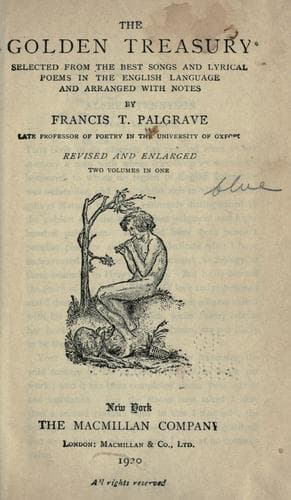
The Golden Treasury: Selected from the Best Songs and Lyrical Poems in the English Language and arranged with Notes
General
The Golden Treasury: Selected from the Best Songs and Lyrical Poems in the English Language and arranged with Notes
English poetry; Songs, English -- Texts
This division, embracing generally the latter eighty years of the
Seventeenth century, contains the close of our Early poetical style
and the commencement of the Modern. In Dryden we see the first master
of the new: in Milton, whose genius dominates here as Shakespeare's in
the former book,--the crown and consummation of the early period.
Their splendid Odes are far in advance of any prior attempts,
Spenser's excepted: they exhibit that wider and grander range which
years and experience and the struggles of the time conferred on
Poetry. Our Muses now give expression to political feeling, to
religious thought, to a high philosophic statesmanship in writers such
as Marvell, Herbert, and Wotton: whilst in Marvell and Milton, again,
we find noble attempts, hitherto rare in our literature, at pure
description of nature, destined in our own age to be continued and
equalled. Meanwhile the poetry of simple passion, although before 1660
often deformed by verbal fancies and conceits of thought, and
afterwards by levity and an artificial tone,--produced in Herrick and
Waller some charming pieces of more finished art than the Elizabethan:
until in the courtly compliments of Sedley it seems to exhaust itself,
and lie almost dormant for the hundred years between the days of
Wither and Suckling and the days of Burns and Cowper.--That the change
from our early style to the modern brought with it at first a loss of
nature and simplicity is undeniable; yet the bolder and wider scope
which Poetry took between 1620 and 1700, and the successful efforts
then made to gain greater clearness in expression, in their results
have been no slight compensation.
PAGE NO.
58 85 l. 8 _whist_: hushed.
-- -- l. 32 _than_: obsolete for _then_: _Pan_: used here for the Lord
of all.
59 -- l. 38 _consort_: Milton's spelling of this word, here and
elsewhere, has been followed, as it is uncertain whether he used it in
the sense of _accompanying_, or simply for _concert_.
61 -- l. 21 _Lars and Lemures_: household gods and spirits of
relations dead. _Flamens_ (l. 24) Roman priests. _That twice-batter'd
god_ (l. 29) Dagon.
62 -- l. 6 _Osiris_, the Egyptian god of Agriculture (here, perhaps by
confusion with Apis, figured as a Bull), was torn to pieces by Typho and
embalmed after death in a sacred chest. This mythe, reproduced in Syria
and Greece in the legends of Thammuz, Adonis, and perhaps Absyrtus, may
have originally signified the annual death of the Sun or the Year under
the influences of the winter darkness. Horus, the son of Osiris, as the
New Year, in his turn overcomes Typho. L. 8 _unshower'd_ grass: as watered
by the Nile only. L. 33 _youngest-teemed_: last-born. _Bright-harness'd_
(l. 37) armoured.
Public-domain text, read in full here on John Shaqi.
Reviews
Reviews
No reviews yet
Be the first to share your thoughts on this work.
Elsewhere in the archive
Join the Discussion
Join the discussion
Sign in to leave a comment or review.
Sign InorCreate an account