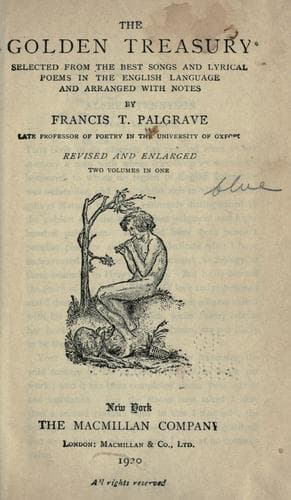
The Golden Treasury: Selected from the Best Songs and Lyrical Poems in the English Language and arranged with Notes
General
The Golden Treasury: Selected from the Best Songs and Lyrical Poems in the English Language and arranged with Notes
English poetry; Songs, English -- Texts
99 127 _From Prison_: to which his active support of Charles I twice
brought the high-spirited writer. L. 7 _Gods_: thus in the original;
Lovelace, in his fanciful way, making here a mythological allusion.
_Birds_, commonly substituted, is without authority. St. 3, l. 1
_committed_: to prison.
100 128 St. 2 l. 4 _blue-god_: Neptune.
104 133 _Waly waly_: an exclamation of sorrow, the root and the
pronunciation of which are preserved in the word _caterwaul_. _Brae_,
hillside: _burn_, brook: _busk_, adorn. _Saint Anton's Well_: below
Arthur's Seat by Edinburgh. _Cramasie_, crimson.
105 134 This beautiful example of early simplicity is found in a
Song-book of 1620.
106 135 _burd_, maiden.
107 136 _corbies_, crows: _fail_, turf: _hause_, neck: _theek_,
thatch.--If not in their origin, in their present form this, with the
preceding poem and 133, appear due to the Seventeenth Century, and
have therefore been placed in Book II.
108 137 The poetical and the prosaic, after Cowley's fashion, blend
curiously in this deeply-felt elegy.
112 141 Perhaps no poem in this collection is more delicately fancied,
more exquisitely finished. By placing his description of the Fawn in a
young girl's mouth, Marvell has, as it were, legitimated that
abundance of 'imaginative hyperbole' to which he is always partial: he
makes us feel it natural that a maiden's favourite should be whiter
than milk, sweeter than sugar--'lilies without, roses within,' The
poet's imagination is justified in its seeming extravagance by the
intensity and unity with which it invests his picture.
113 142 The remark quoted in the note to No. 65 applies equally to
these truly wonderful verses. Marvell here throws himself into the
very soul of the _Garden_ with the imaginative intensity of Shelley in
his _West Wind_.--This poem appears also as a translation in Marvell's
works. The most striking verses in it, here quoted as the book is
rare, answer more or less to stanzas 2 and 6:--
Alma Quies, teneo te! et te, germana Quietis,
Simplicitas! vos ergo diu per templa, per urbes
Quaesivi, regum perque alta palatia, frustra:
Sed vos hortorum per opaca silentia, longe
Celarunt plantae virides, et concolor umbra.
115 143 St. 3 _tutties_: nosegays. St. 4 _silly_: simple.
_L'Allégro_ and _Il Penseroso_. It is a striking proof of Milton's
astonishing power, that these, the earliest great Lyrics of the
Landscape in our language, should still remain supreme in their style
for range, variety, and melodious beauty. The Bright and the
Thoughtful aspects of Nature and of Life are their subjects: but each
is preceded by a mythological introduction in a mixed Classical and
Italian manner.--With that of _L'Allégro_ may be compared a similar
mythe in the first Section of the first Book of S. Marmion's graceful
_Cupid and Psyche_, 1637.
Public-domain text, read in full here on John Shaqi.
Reviews
Reviews
No reviews yet
Be the first to share your thoughts on this work.
Elsewhere in the archive
Join the Discussion
Join the discussion
Sign in to leave a comment or review.
Sign InorCreate an account