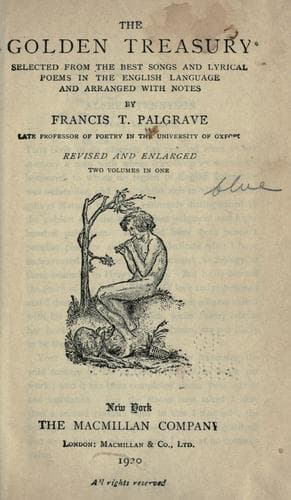
The Golden Treasury: Selected from the Best Songs and Lyrical Poems in the English Language and arranged with Notes
General
The Golden Treasury: Selected from the Best Songs and Lyrical Poems in the English Language and arranged with Notes
English poetry; Songs, English -- Texts
It is more difficult to characterize the English Poetry of the
Eighteenth century than that of any other. For it was an age not only
of spontaneous transition, but of bold experiment: it includes not
only such absolute contrasts as distinguish the 'Rape of the Lock'
from the 'Parish Register,' but such vast contemporaneous differences
as lie between Pope and Collins, Burns and Cowper. Yet we may clearly
trace three leading moods or tendencies:--the aspects of courtly or
educated life represented by Pope and carried to exhaustion by his
followers; the poetry of Nature and of Man, viewed through a
cultivated, and at the same time an impassioned frame of mind by
Collins and Gray:--lastly, the study of vivid and simple narrative,
including natural description, begun by Gay and Thomson, pursued by
Burns and others in the north, and established in England by
Goldsmith, Percy, Crabbe, and Cowper. Great varieties in style
accompanied these diversities in aim: poets could not always
distinguish the manner suitable for subjects so far apart: and the
union of conventional and of common language, exhibited most
conspicuously by Burns, has given a tone to the poetry of that century
which is better explained by reference to its historical origin than
by naming it artificial. There is, again, a nobleness of thought, a
courageous aim at high and, in a strict sense manly, excellence in
many of the writers:--nor can that period be justly termed tame and
wanting in originality, which produced poems such as Pope's Satires,
Gray's Odes and Elegy, the ballads of Gay and Carey, the songs of
Burns and Cowper. In truth Poetry at this, as at all times, was a more
or less unconscious mirror of the genius of the age: and the many
complex causes which made the Eighteenth century the turning-time in
modern European civilization are also more or less reflected in its
verse. An intelligent reader will find the influence of Newton as
markedly in the poems of Pope, as of Elizabeth in the plays of
Shakespeare. On this great subject, however, these indications must
here be sufficient.
PAGE NO.
Public-domain text, read in full here on John Shaqi.
Reviews
Reviews
No reviews yet
Be the first to share your thoughts on this work.
Elsewhere in the archive
Join the Discussion
Join the discussion
Sign in to leave a comment or review.
Sign InorCreate an account