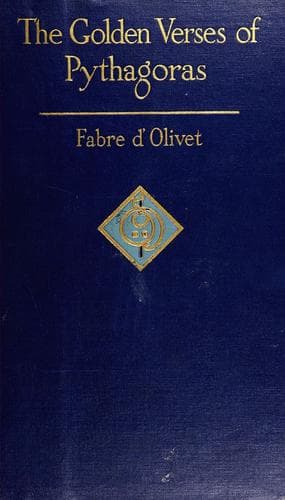
The golden verses of PythagorasFabre d'Olivet, Antoine
Religion
The golden verses of Pythagoras
Fabre d'Olivet, Antoine
Poetry -- History and criticism; Pythagoras and Pythagorean school
Lysis continues, in the name of Pythagoras, to trace for the
philosopher the course that he must follow in the first part of his
doctrine, which is the Purification. After having commended to him
moderation and prudence in all things, having exhorted him to be as
slow to censure as to approve, he seeks to put him on guard against
prejudices and the routine of example, which are, in reality, the
greatest obstacles that are encountered by science and truth. This is
what Bacon, the regenerator of philosophy in modern Europe, so keenly
felt, as I have already cited with praise at the opening of this work.
This excellent observer, to whom we owe our freedom from scholastic
leading-strings whose ignorance had stifled for us the name of
Aristotle, having formed the difficult enterprise of disencumbering
and, as it were, clearing the air belonging to the human
understanding, in order to put it in a condition to receive an edifice
less barbarous, remarked, that one would never attain to establishing
there the foundation of true science, if one did not first labour to
set aside prejudices.[415] He displayed all his forces against these
formidable enemies of human perfectibility, and if he did not
overthrow them all, at least he indicated them in such a manner as to
make it easier to recognize and destroy them. The prejudices which
obsess the human understanding and which he calls idols, are,
according to him, of four kinds: these are the idols of the tribe; the
idols of the den; the idols of society; and the idols of theories. The
first are inherent in human nature; the second are those of each
individual; the third result from the equivocal definitions attached
to words; the fourth and the most numerous are those that man receives
from his teachers and from the doctrines which are current.[416] The
last are the most tenacious and the most difficult to conquer. It
seems even impossible wholly to resist them. The man who aspires to
the perilous glory of improving the human mind, finds himself placed
between two formidable dangers, which, like those of Sylla and
Charybdis, threaten alternately to break his frail bark: upon one is
irresistible routine, upon the other proud innovation. There is danger
alike from both sides. He can save himself only by favour of the
golden mean, so commended by all the sages and so rarely followed even
by them.
Public-domain text, read in full here on John Shaqi.
Reviews
Reviews
No reviews yet
Be the first to share your thoughts on this work.
Elsewhere in the archive
Join the Discussion
Join the discussion
Sign in to leave a comment or review.
Sign InorCreate an account