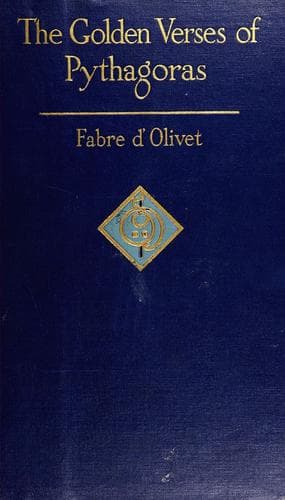
The golden verses of PythagorasFabre d'Olivet, Antoine
Religion
The golden verses of Pythagoras
Fabre d'Olivet, Antoine
Poetry -- History and criticism; Pythagoras and Pythagorean school
Let us observe this closely. The future is composed of the past――that
is to say, that the route that man traverses in time, and that he
modifies by means of the power of his will, he has already traversed
and modified; in the same manner, using a practical illustration, that
the earth describing its annual orbit around the sun, according to the
modern system, traverses the same spaces and sees unfold around it
almost the same aspects: so that, following anew a route that he has
traced for himself, man would be able not only to recognize the
imprints of his steps, but to foresee the objects that he is about to
encounter, since he has already seen them, if his memory preserved the
image, and if this image was not effaced by the necessary consequence
of his nature and the providential laws which rule him. Such is the
doctrine of Pythagoras as I have already revealed.[435] It was that of
the mysteries and of all the sages of antiquity. Origen, who has
opposed it, attributes it to the Egyptians, to the Pythagoreans, and
to the disciples of Plato. It was contained in the sacred books of the
Chaldeans, cited by Syncellus, under the title of _livres
géniques_.[436] Seneca and Synesius have supported it as wholly in
accordance with the spirit of the initiations.[437] What the ancients
called the _great year_, was a consequence of this doctrine; for it
was taught in the mysteries, that the Universe itself traversed, after
a sequence of incalculable centuries, the same revolutions that it had
already traversed, and brought around in the vast unfolding of its
concentric spheres, as much for it as for the worlds which compose it,
the succession of the four ages, the duration of which, relative to
the nature of each being, immense for the Universal Man, is limited in
the individual to what is called infancy, youth, manhood, and old age,
and is represented on the earth by the fleeting seasons of spring,
summer, autumn, and winter. This great year, thus conceived, has been
common to all the peoples of the earth.[438] Cicero has plainly seen
that it constituted the veritable basis of genethlialogy or the
astrological science.[439] Indeed if the future is composed of the
past――that is, a thing already made, upon which the present is
gradually unfolded as upon the circumference of a circle which has
neither beginning nor end, it is evident that one can succeed, up to a
certain point, to recognize it, whether by means of remembrance, by
examining in the past, the picture of the whole revolution; or by
means of prevision carrying the moral sight, more or less far, upon
the route through which the Universe is passing. These two methods
have grave disadvantages. The first appears even impossible. For what
is the duration of the great year? What is the immense period, which,
containing the circle of all possible aspects and of all corresponding
effects, as Cicero supposes, is able, by observations made and set
Public-domain text, read in full here on John Shaqi.
Reviews
Reviews
No reviews yet
Be the first to share your thoughts on this work.
Elsewhere in the archive
Join the Discussion
Join the discussion
Sign in to leave a comment or review.
Sign InorCreate an account