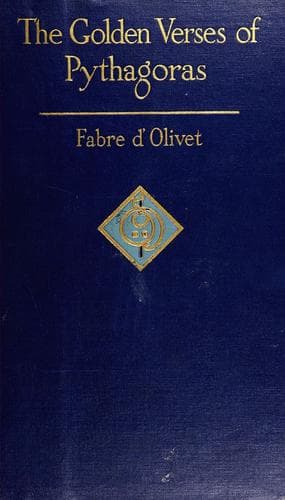
The golden verses of PythagorasFabre d'Olivet, Antoine
Religion
The golden verses of Pythagoras
Fabre d'Olivet, Antoine
Poetry -- History and criticism; Pythagoras and Pythagorean school
However, I do not pretend to say that all the modern savants indulge,
in this same manner, in presumption and false notions with regard to
antiquity; there have been many honourable exceptions among them: even
those have been found who, drawn beyond the golden mean, by the
necessity of effecting a useful reform or of establishing a new
system, have returned there as soon as their passion or their interest
have no longer commanded them. Such for example is Bacon, to whom
philosophy has owed enough great favours to forget certain incidental
prejudices; for I am, furthermore, far from attributing to him the
errors of his disciples. Bacon, at the risk of contradicting himself,
yielding to the sentiment of truth, although he subjected all to the
light of experience, admitted, however, positive and real universals,
which, by his method are wholly inexplicable.[462] Forgetting what he
had said of Plato in one book, he declared in another: that this
philosopher, endowed with a sublime genius, turning his attention upon
all nature and contemplating all things from a lofty elevation, had
seen very clearly, in his doctrine of ideas, what the veritable
objects of science are.[463] Finally recognizing the principles of
physics and the _ensemble_ of things as the foremost to be considered,
he made astrological science, which he likened to astronomy, depend
upon it, in such a manner as to show that he did not confound it with
vulgar astrology. This philosopher found that before his time,
astronomy, well enough founded upon phenomena, utterly lacked
soundness, and that astrology had lost its true principles. To be sure
he agreed with astronomy presenting the exterior of celestial
phenomena, that is to say, the number, situation, movement, and
periods of the stars; but he accused it of lacking in understanding of
the physical reasons of these phenomena. He believed that a single
theory which contents itself with appearances is a very easy thing,
and that one can imagine an infinity of speculations of this sort;
also he wished that the science of astronomy might be further
advanced.
Instead of revealing the reasons of celestial phenomena [he
said], one is occupied only with observations and
mathematical demonstrations; for these observations and
these demonstrations can indeed furnish certain ingenious
hypotheses to settle all that in one’s mind, and to make an
idea of this assemblage, but not to know precisely how and
why all this is actually in nature: they indicate, at the
most, the apparent movements, the artificial assemblage, the
arbitrary combination of all these phenomena, but not the
veritable causes and the reality of things: and as to this
subject [he continues], it is with very little judgment that
astronomy is ranked among the mathematical sciences; this
classification derogates from its dignity.[464]
Public-domain text, read in full here on John Shaqi.
Reviews
Reviews
No reviews yet
Be the first to share your thoughts on this work.
Elsewhere in the archive
Join the Discussion
Join the discussion
Sign in to leave a comment or review.
Sign InorCreate an account