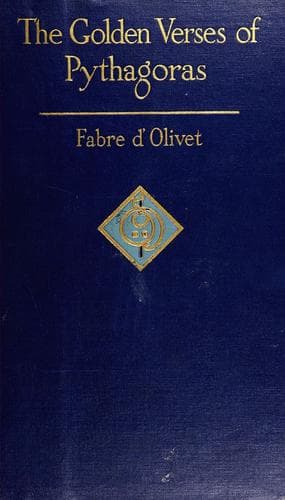
The golden verses of PythagorasFabre d'Olivet, Antoine
Religion
The golden verses of Pythagoras
Fabre d'Olivet, Antoine
Poetry -- History and criticism; Pythagoras and Pythagorean school
Lysis, after having indicated the route by which Pythagoras conducted
his disciples to virtue, goes on to teach them the use that this
philosopher wished them to make of this celestial gift, once they had
mastered it. Up to this point it is confined in the purgative part of
the doctrine of his teacher; he now passes to the unitive part, that
is to say, to that which has as object the uniting of man to the
Divinity, by rendering him more and more like unto the model of all
perfection and of all wisdom, which is God. The sole instrument
capable of operating this union has been placed at his disposition by
means of the good usage that he has made of his will: it is virtue
which must serve him at present to attain truth. Now, Truth is the
ultimate goal of perfection: there is nothing beyond it and nothing
this side of it but error; light springs from it; it is the soul of
God, according to Pythagoras,[480] and God himself, according to the
legislator of the Indians.[481]
The first precept that Pythagoras gave to his disciples on entering
the course of perfection tended to turn their thoughts upon
themselves, to bring them to interrogate their actions, their
thoughts, their discourse, to question the motives, to reflect in
short upon their exterior movements and seek thus to know themselves.
Knowledge of self was the most important knowledge of all, that which
must conduct them to all others. I will not weary my readers by adding
anything to what I have already said pertaining to the importance of
this knowledge, and the extreme value set upon it by the ancients.
They know unquestionably that the morals of Socrates and the
philosophy of Plato were only the development of it and that an
inscription in the temple of Greece, that of Delphi, commended it,
after that of the golden mean, as the very teaching of the God whom
they worshipped there[482]: _Nothing in excess, and know Thyself_,
contained in few words the doctrine of the sages, and presented for
their meditation the principles upon which reposed virtue and wisdom
which is its consequence. Nothing further was necessary to electrify
the soul of Heraclitus and to develop the germs of genius, which until
the moment when he read these two sentences were buried in a cold
inertia.
Public-domain text, read in full here on John Shaqi.
Reviews
Reviews
No reviews yet
Be the first to share your thoughts on this work.
Elsewhere in the archive
Join the Discussion
Join the discussion
Sign in to leave a comment or review.
Sign InorCreate an account