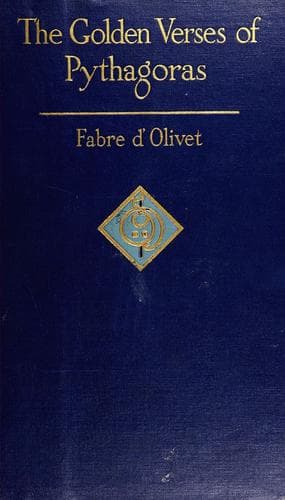
The golden verses of PythagorasFabre d'Olivet, Antoine
Religion
The golden verses of Pythagoras
Fabre d'Olivet, Antoine
Poetry -- History and criticism; Pythagoras and Pythagorean school
One can easily see that the faculty which Kant designates by the word
_Empfindlichkeit_, sense perception, belongs to the physical part of
man; and that which he expresses by the word _Verstand_, the
understanding, resides in his animistic part; but one cannot see at
all that what he names _Vernunft_, and which he continually confounds
with reason, may be able in any manner to dominate in his intellectual
part. For this, it would be necessary that he should consider it under
the relation of the intelligence; which he has not done. It is very
true that he has wished to place it constantly in the mind, by
representing the three faculties of which man is composed as a sort of
hierarchy, of which sense perception occupies the base, understanding
the centre, and reason the summit; or as one of his translators said,
imagining this hierarchy under the emblem of an empire, of which sense
perception constitutes the subjects, understanding the agents or
ministers, and reason the sovereign or legislator.[512] I cannot
conceive how Kant, by giving the word _Vernunft_, the meaning of the
Latin word _ratio_, has been able to say that it is the highest degree
of the activity of a mind which has the power of all its liberty, and
the consciousness of all its strength[513]: there is nothing more
false. Reason does not exist in liberty, but on the contrary, in
necessity. Its movement, which is geometric, is always forced: it is
an inference from the point of departure, and nothing more. Let us
examine this carefully. The Latin word _ratio_, whose meaning Kant has
visibly followed, has never translated exactly the Greek word _logos_,
in the sense of _word_; and if the Greek philosophers have substituted
sometimes the _logos_ for _nous_, or the word for the intelligence, by
taking the effect for the cause, it is wrong when the Romans have
tried to imitate them, by using _ratio_, in place of _mens_, or
_intelligentia_. In this they have proved their ignorance and have
disclosed the calamitous ravages that skepticism had already made
among them. The word _ratio_ springs from the root _ra_ or _rat_,
which in all the tongues where it has been received, has carried the
idea of a _ray_, a straight line drawn from one point to another.[514]
Thus reason, far from being free as Kant has pretended, is what is the
most constrained in nature: it is a geometric line, always subject to
the point whence it emanates, and forced to strike the point toward
which it is directed under penalty of ceasing to be itself; that is to
say, of ceasing to be straight. Now, reason not being free in its
course, is neither good nor bad in itself; it is always analogous to
the principle of which it is the inference. Its nature is to go
straight; its perfection is nothing else. One goes straight in every
way, in every direction, high, low, to right, to left; one reasons
correctly in truth as in error, in vice as in virtue: all depends upon
Public-domain text, read in full here on John Shaqi.
Reviews
Reviews
No reviews yet
Be the first to share your thoughts on this work.
Elsewhere in the archive
Join the Discussion
Join the discussion
Sign in to leave a comment or review.
Sign InorCreate an account