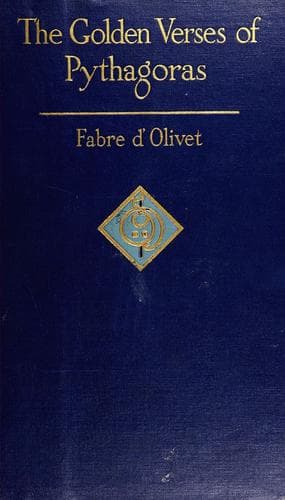
The golden verses of PythagorasFabre d'Olivet, Antoine
Religion
The golden verses of Pythagoras
Fabre d'Olivet, Antoine
Poetry -- History and criticism; Pythagoras and Pythagorean school
I have spoken at considerable length of the skeptics; but I have
believed it necessary in explaining a dogmatic work, whose _esprit_ is
wholly opposed to that of skepticism. When Lysis wrote in Greece,
there had been no one as yet who doubted either the existence of the
gods, or that of the Universe, or made the distinction between good
and evil, virtue and vice. Arcesilaus and Pyrrho were not born, and
the clouds that they raised afterwards concerning these great subjects
of the meditation of the sages were not even suspected. The minds had
inclined rather toward credulity than toward doubt; toward
superstition than toward atheism; it was more necessary to limit their
curiosity than to excite their indifference. At that epoch, the
philosophers enveloped the truth with veils, and rendered the avenues
of science difficult, so that the vulgar might not profane them. They
knew what had been too long forgotten: that all kinds of wood are not
fitting to make a Mercury. Also their writers were obscure and
sententious: in order to dishearten, not those who might be able to
doubt, but those who were not in a condition to comprehend.
Today, as the minds are changed, it is of more importance to attract
those who are able to receive the truth, than to keep at a distance
those who are unable to receive it; the latter, separating themselves,
are persuaded that they either possess it or have no need of it. I
have given the history of skepticism; I have shown its origin and the
sorry effects of its absolute and disordered influence; not in order
to bring back the skeptics of the profession, but to endeavour to
prevent the men who are still drifting in uncertainty from becoming
so. I have essayed to show them by the example of one of the greatest
reasoners of Germany, by the example of Kant, that reason alone, with
whatever talents it may be accompanied, cannot fail to lead them to
nothingness. I have made them see that this faculty so lauded is
nothing of itself. I am content with the example of the Koenigsberg
professor; but had I not feared prolixities, I would have added the
example of Berkeley and that of Spinoza. The varied catastrophes of
these three savants form a striking contrast. Kant, following step by
step his pure Reason, comes to see that the knowledge of intelligible
things is impossible and finds matter; Berkeley, led by the same
reason, proves that the existence of matter is illusory, and that all
is spirit; Spinoza, drawing irresistible arguments from this same
faculty, shows that there exists and can exist only one sole substance
and that therefore spirit and matter are but one. And do not think
that, armed with reason alone, you can combat separately Spinoza,
Berkeley, or Kant: their contradictory systems will clash in vain;
they will triumph over you and will push you into the dark and
bottomless abyss of skepticism.
Public-domain text, read in full here on John Shaqi.
Reviews
Reviews
No reviews yet
Be the first to share your thoughts on this work.
Elsewhere in the archive
Join the Discussion
Join the discussion
Sign in to leave a comment or review.
Sign InorCreate an account