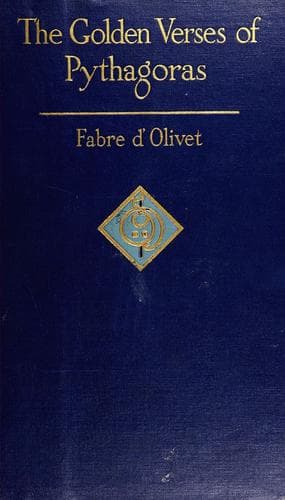
The golden verses of PythagorasFabre d'Olivet, Antoine
Religion
The golden verses of Pythagoras
Fabre d'Olivet, Antoine
Poetry -- History and criticism; Pythagoras and Pythagorean school
The Chinese people, from time immemorial, have been divided into four
great classes, relative to the rank that men occupy in society,
following the functions that they execute therein,[549] very nearly as
do the Indians: but this division, that long custom has rendered
purely political, is looked upon very differently by the philosophers.
Man, according to them, constitutes one of the three productive powers
which compose the median trinity of the Universe; for they consider
the Universe, or the great All, as the expression of a triple Trinity
enveloped and dominated by the primordial Unity: which constitutes for
them a decade instead of a Quaternary. This third power called _Yin_,
that is to say, mankind, is subdivided into three principal classes,
which by means of the intermediary classes admitted by Kong-Tse,
produces the five classes spoken of by this sage.
The first class, the most numerous, comprises [he said] that
multitude of men who act only by a sort of imitative
_instinct_, doing today what they did yesterday, in order to
recommence tomorrow what they have done today; and who,
incapable of discerning in the distance the real and
substantial advantages, the interest of highest importance,
extract easily a little profit, a base interest in the
pettiest things, and have enough adroitness to procure them.
These men have an _understanding_ as the others but this
understanding goes no further than the _senses_; they see
and hear only through the eyes and the ears of their bodies.
Such are the people.
The second class is composed [according to the same sage] of
men instructed in the sciences, in letters and in the
liberal arts. These men have an object in view in whatever
they undertake, and know the different means by which the
end can be accomplished; they have not penetrated into the
essence of things, but they know them well enough to speak
of them with ease and to give lessons to others; whether
they speak or whether they act, they can give _reason_ for
what they say or what they do, comparing subjects among them
and drawing just inferences concerning what is harmful or
profitable: these are the artists, the _literati_, who are
occupied with things wherein _reasoning_ must enter. This
class can have an influence on customs and even on the
government.
Public-domain text, read in full here on John Shaqi.
Reviews
Reviews
No reviews yet
Be the first to share your thoughts on this work.
Elsewhere in the archive
Join the Discussion
Join the discussion
Sign in to leave a comment or review.
Sign InorCreate an account