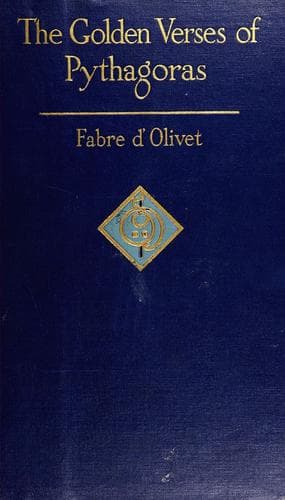
The golden verses of PythagorasFabre d'Olivet, Antoine
Religion
The golden verses of Pythagoras
Fabre d'Olivet, Antoine
Poetry -- History and criticism; Pythagoras and Pythagorean school
Without perplexing ourselves, therefore, with the constitutive
principles of the Pythagorean Quaternary, let us content ourselves
with knowing that it was the general emblem of anything moving by
itself and manifesting by its facultative modifications; for according
to Pythagoras, 1 and 2 represent the hidden principles of things; 3,
their faculties, and 4, their proper essence. These four numbers
which, united by addition produce the number 10, constituted the
Being, as much universal as particular; so that the Quaternary, which
is as its virtue, could become the emblem of all beings, since there
is none which may not recognize the principles, and which does not
manifest itself by faculties more or less perfect, and which may not
enjoy an existence universal or relative; but the being to which
Pythagoras applied it most commonly was Man. Man, as I have said,
manifests himself as does the Universe, under the three principal
modifications of body, soul, and spirit. The unknown principles of
this first Ternary are what Plato calls the _same_, and the _other_,
the _indivisible_ and the _divisible_. The indivisible principle gives
the spirit; the divisible the body; and the soul has birth from this
last principle elaborated by the first.[553] Such was the doctrine of
Pythagoras which was borrowed by Plato. It had been that of the
Egyptians, as can be seen in the works which remain to us under the
name of Hermes. Synesius, who had been initiated into their mysteries,
said particularly, that human souls emanated from two sources: the one
luminous, which flows from heaven on high; the other tenebrous, which
springs from the earth in the abysmal depths of which it finds its
origin.[554] The early Christians, faithful to theosophical tradition,
followed the same teaching; they established a great difference
between the spirit and the soul. They considered the soul as an issue
of the material principle, and in consequence being neither
enlightened nor virtuous in itself. The spirit, said Basil, is a gift
of God: it is the soul of the soul, as it were; it is united to the
soul; it enlightens it, it rescues it from earth and raises it to
heaven.[555] Beausobre, who relates these words, observes that this
sentiment was common to several Fathers of the primitive church,
particularly to Tatian.[556]
I have spoken often of this first Ternary, and even of the triple
faculties which are attached to each of its modifications; but as I
have done many times, I believe it useful to present here the
_ensemble_, so as to have the opportunity of uniting, under the same
viewpoint, the volitive unity, from which results the human
Quaternary, in general, and in the particular being, which is man.
Public-domain text, read in full here on John Shaqi.
Reviews
Reviews
No reviews yet
Be the first to share your thoughts on this work.
Elsewhere in the archive
Join the Discussion
Join the discussion
Sign in to leave a comment or review.
Sign InorCreate an account