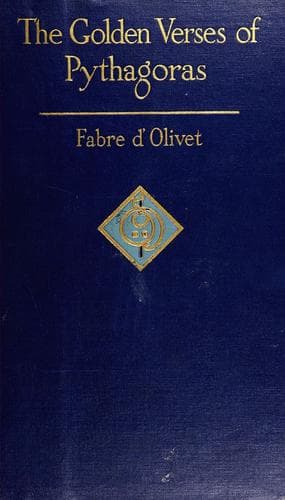
The golden verses of PythagorasFabre d'Olivet, Antoine
Religion
The golden verses of Pythagoras
Fabre d'Olivet, Antoine
Poetry -- History and criticism; Pythagoras and Pythagorean school
Man, who aspires by the inner movement of his will, to attain to the
highest degree of human perfection, and who, by the purification of
his understanding, and the acquisition of celestial virtues, puts
himself in a state to receive the truth, must observe that the higher
he rises in the intelligible sphere, the nearer he approaches to the
unfathomable Being whose contemplation must make his happiness, the
less he can communicate the knowledge of it to others; for truth,
coming to him under intelligible forms more and more universalized,
can never be contained in the rational or sentient forms that he might
give it. Here is the point where many mystic contemplators have gone
astray. As they had never adequately fathomed the triple modification
of their being, and as they had not known the intimate composition of
the human Quaternary, they were ignorant of the manner in which the
transformation of ideas was made, as much in the ascendant progression
as in the descendant progression; so that, confusing continually
understanding and intelligence, and making no difference between the
products of their will according as it acted in one or the other of
its modifications, they often showed the opposite of what they
intended to show; and instead of the seers that they might, perhaps,
have been, they became visionaries. I could give a great many examples
of these aberrations; but I will limit myself to a single one, because
the man who furnishes it for me, immeasurably great on the side of
intelligence, lacked understanding and felt keenly himself, the
weakness of his reason. This man, whose audacious gaze has penetrated
as far as the divine sanctuary, is a German shoemaker of obscure
birth, called Jacob Boehme. The rusticity of his mind, the roughness
of his character, and more than all that, the force and the number of
his prejudices, render his works almost unintelligible and therefore
repel the savants. But when one has the patience and talent necessary
to separate the pure gold from its dross and from its alloy, one can
find there things which are nowhere else. These things, which present
themselves nearly always under the oddest and most absurd forms, have
taken them by passing from his intelligence to his instinct, without
his reason having had the force to oppose itself. This is how he
artlessly expresses this transformation of ideas: “Now that I have
raised myself so high, I dare not look back for fear that giddiness
may seize me … for as long as I ascend, I am convinced of my impulse;
but it is not the same when I turn my head and when I wish to descend;
then I am troubled, I am bewildered, it seems to me that I shall
fall.”[594] And in truth he fell so rapidly that he did not perceive,
either the terrible disparity between his ideas and his expressions,
nor the manifest contradictions into which his prejudices had drawn
him.
Public-domain text, read in full here on John Shaqi.
Reviews
Reviews
No reviews yet
Be the first to share your thoughts on this work.
Elsewhere in the archive
Join the Discussion
Join the discussion
Sign in to leave a comment or review.
Sign InorCreate an account