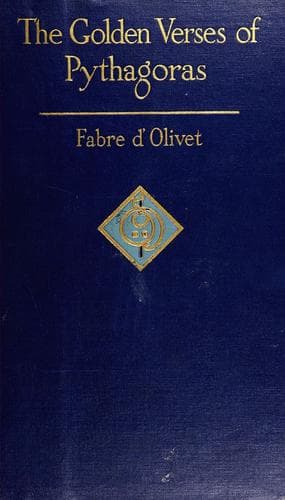
The golden verses of PythagorasFabre d'Olivet, Antoine
Religion
The golden verses of Pythagoras
Fabre d'Olivet, Antoine
Poetry -- History and criticism; Pythagoras and Pythagorean school
Again I say, that the Divinity considered in the instinct is presented
under the emblem of material infinity: hence, all cults where, by a
contrary movement, the intelligible becomes sentient and the sentient
intelligible; as when the attributes and faculties of the Divinity are
particularized and personified, and as the agents of Nature, the parts
of the Universe and the individual beings themselves, are deified.
This cult, to which I have given the name of _Polytheism_, is
everywhere, under different forms and under different names, the
portion of the vulgar. More or less apparent it insinuates itself in
the midst of the other two, multiplies the images of the intellectual
modifications and the natural principles, and whatever attentions the
theosophists bring to forestall its invasion, end by stifling utterly
the spirit of it beneath the material covering which envelops them.
This cult, the cradle of all religions, with which the other two can
never entirely dispense, which nourishes and lives in their life, is
also the tomb. It pleases singularly that faculty of man which is
developed first, sense perception; it aids the development of instinct
and can, by the sole medium of common sense, lead to the knowledge of
the natural principles. Its abuse precipitates peoples into idolatry
and superstition; its good use arouses the talents and gives birth to
heroic virtues. One becomes artist or hero through the exaltation of
Polytheism; savant or philosopher through that of Diarchy; and sage or
theosophist through that of Tritheism. These three cults, whether pure
or variously mixed, are the only ones in which transformation may be
possible; that is to say, which may be clothed in ostensible forms and
enclosed in any sort of ritual. The fourth cult, which is founded upon
the absolute unity of God, is not transformable. This is the reason.
Public-domain text, read in full here on John Shaqi.
Reviews
Reviews
No reviews yet
Be the first to share your thoughts on this work.
Elsewhere in the archive
Join the Discussion
Join the discussion
Sign in to leave a comment or review.
Sign InorCreate an account