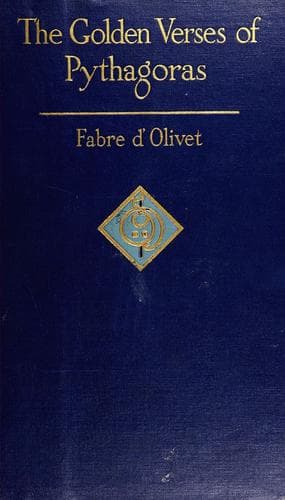
The golden verses of PythagorasFabre d'Olivet, Antoine
Religion
The golden verses of Pythagoras
Fabre d'Olivet, Antoine
Poetry -- History and criticism; Pythagoras and Pythagorean school
I have already said that the homogeneity of Nature was, with the unity
of God, one of the greatest secrets of the mysteries. Pythagoras
founded this homogeneity upon the unity of the spirit by which it is
penetrated and from which, according to him, all our souls draw their
origin.[606] This dogma which he had received from the Chaldeans and
from the priests of Egypt was admitted by all the sages of antiquity,
as is proved at great length by Stanley and the astute Beausobre.[607]
These sages established a harmony, a perfect analogy between heaven
and earth, the intelligible and the sentient, the indivisible
substance and the divisible substance; in such a manner that that
which took place in one of the regions of the Universe or of the
modifications of the primordial Ternary was the exact image of that
which took place in the other. This idea is found very forcibly
revealed by the ancient Thoth, called _Hermes Trismegistus_,[608] by
the Greeks, in the table of Emerald which is attributed to him.
In truth, and without fiction, in truth, in truth, I say to
you, that things inferior are like unto the superior; both
unite their invincible forces to produce one sole thing, the
most marvellous of all, and as all things are emanated by
the will of one unique God, thus all things whatsoever must
be engendered by this sole thing,――by a disposition of
Universal nature.[609]
I must say, however, that it is upon the homogeneity of Nature that
were founded in the principle all the so-called occult sciences of
which the principal four, relating to the human Quaternary, were
Theurgy, Astrology, Magic, and Chemistry.[610] I have already spoken
of the astrological science, and I have given sufficient evidence of
what I think regarding the ridiculous and petty ideas concerning it
that the modems have conceived. I will refrain from speaking of the
other three, on account of the prolixities into which the discussions
that they would provoke might lure me. In another work I will
endeavour to show that the principles upon which they were supported
differed greatly from those which superstition and blind credulity
have given them in times of ignorance; and that the sciences taught to
the initiates in the ancient sanctuaries, under the names of Theurgy,
Magic, or Chemistry, differed much from what the vulgar have
understood in later times by the same words.
29. _So that, as to thy true rights enlightened,
Thine heart shall no more feed on vain desires._
Public-domain text, read in full here on John Shaqi.
Reviews
Reviews
No reviews yet
Be the first to share your thoughts on this work.
Elsewhere in the archive
Join the Discussion
Join the discussion
Sign in to leave a comment or review.
Sign InorCreate an account