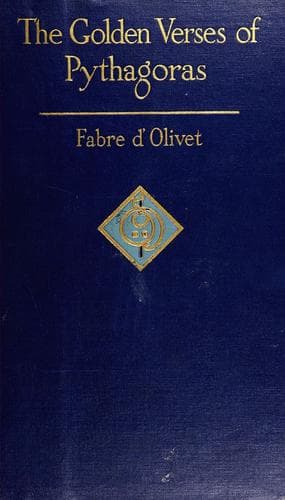
The golden verses of PythagorasFabre d'Olivet, Antoine
Religion
The golden verses of Pythagoras
Fabre d'Olivet, Antoine
Poetry -- History and criticism; Pythagoras and Pythagorean school
“In the beginning, when naught was, there
Was neither sand nor sea nor the cold waves,
Nor was earth to be seen nor heaven above.
There was a Yawning Chasm [chaos] but grass nowhere.…”
_Ár vas aida pat-es ekki vas;
vasa sandr né sær né svalar unnir,
iœr[x]o fansk æva né upp-himinn;
Gap vas Ginnunga, enn gras ekki,_ …
Voyez Mallet, _Monuments celtiques_, p. 135; et pour le
texte, le poëme même de la Voluspa, _in Edda islandorum_,
Mallet paraît avoir suivi un texte erroné.
As to the Gallic poetry of the Scotch bards, that Macpherson
has made known to us under the name of _Ossian_, much is
needed that they may have a sufficient degree of
authenticity for them to be cited as models, and placed
parallel with those of Homer, as has been done without
reflection. These poems, although resting for the greater
part upon a true basis, are very far from being veritable as
to form. The Scotch bards, like the Oscan troubadours, must
be restored and often entirely remade, if they are to be
read. Macpherson, in composing his _Ossian_, has followed
certain ancient traditions, has put together certain
scattered fragments; but has taken great liberties with all
the rest. He was, besides, a man endowed with creative
genius and he might have been able to attain to epopœia if
he had been better informed. His lack of knowledge has left
a void in his work which demonstrates its falsity. There
is no mythology, no allegory, no cult in _Ossian_. There
are some historic or romanesque facts joined to long
descriptions; it is a style more emphatic than figurative,
more bizarre than original. Macpherson, in neglecting all
kinds of mythological and religious ideas, in even mocking
here and there the _stone of power_ of the Scandinavians,
has shown that he was ignorant of two important things: the
one, that the allegorical or religious genius constitutes
the essence of poetry; the other, that Scotland was at a
very ancient period the hearth of this same genius whose
interpreters were the druids, bards, and scalds. He should
have known that, far from being without religion, the
Caledonians possessed in the heart of their mountains, the
Gallic Parnassus, the sacred mountain of the Occidental
isles; and that when the antique cult began to decline in
Gaul, it was in Albion, reckoned among the holy isles by
even the Indians, that the druids went to study. Voyez
_Les Commentaires de César_, iv., 20; _L’Introduction de
l’histoire de Danemark_, par Mallet; _L’Histoire des
Celtes_, par Pelloutier; et enfin les _Recherches
asiatiques_ (_Asiat. Research._), t. vi., p. 490 et 502.
Public-domain text, read in full here on John Shaqi.
Reviews
Reviews
No reviews yet
Be the first to share your thoughts on this work.
Elsewhere in the archive
Join the Discussion
Join the discussion
Sign in to leave a comment or review.
Sign InorCreate an account