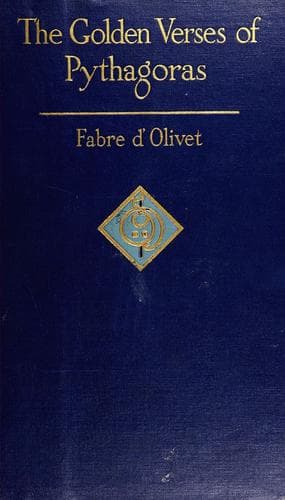
The golden verses of PythagorasFabre d'Olivet, Antoine
Religion
The golden verses of Pythagoras
Fabre d'Olivet, Antoine
Poetry -- History and criticism; Pythagoras and Pythagorean school
Rome, l’unique objet de mon ressentiment!
Rome, à qui vient ton bras d’immoler mon amant!
Feminine, as in:
Rome qui t’a vu naître et que ton cœur adore!
Rome enfin que je hais parce qu’elle t’honore!
In rhymed verses, such as these I have just cited, two feet of the
same kind are obliged to follow one another on account of the rhyme
which links them; they then form but one whole and, proceeding abreast
without being separated, they injure by their forced mass the rapidity
of expression and flight of thought. If a third foot of the same kind
occur with the other two feet, rhyming together, it would have to
rhyme with them to prevent an insupportable discordance, which is not
tolerated; a fourth or a fifth foot would submit to the same law, so
that, if the poet wished to fill his piece with masculine verses
alone, it would be necessary that he should make them proceed upon a
single rhyme, as the Arabs do today and as our early troubadours did,
following their example. The French poet can vary his rhyme only by
varying the style of his verses and by mingling alternately together
the masculine and feminine finals.
As these two kinds of finals are dissimilar without being opposed,
they may be brought together without the need of rhyming; their
meeting, far from being disagreeable is, on the contrary, only
pleasing; two finals of the same kind, whether masculine or feminine,
can never clash without causing the same sound――that is, without
rhyming; but it is not thus with the finals of different kinds, since
the rhyme is impossible in this case. So that, to make what I call
eumolpique verses, it suffices to avoid the meeting of finals of the
same kind, whose impact necessitates the rhyme, by making one kind
succeed another continually, and opposing alternately the masculine
and feminine, the mingling of which is irrelevant to eumolpœia. Here
is all the mechanism of my verses: they are fluent as to form; as to
the essence which is expedient for them――that is another thing: for it
is rarely encountered.
Those who have made blank verse in French have spoken justly of it
with the greatest contempt; these verses, miserable as to substance,
without poetic fire, written as the flattest prose, lacking movement
and grace, had, furthermore, the insupportable fault of not
recognizing the genius of the French tongue, by making finals of the
same kind clash constantly, and by not distinguishing that which is
called rhyme from that which repels it.
Public-domain text, read in full here on John Shaqi.
Reviews
Reviews
No reviews yet
Be the first to share your thoughts on this work.
Join the Discussion
Join the discussion
Sign in to leave a comment or review.
Sign InorCreate an account