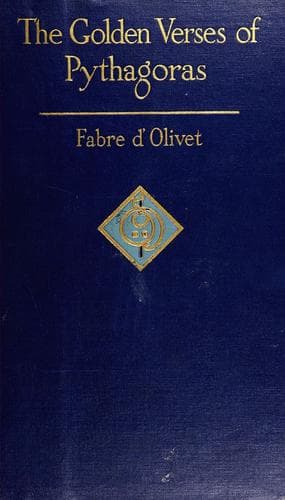
The golden verses of PythagorasFabre d'Olivet, Antoine
Religion
The golden verses of Pythagoras
Fabre d'Olivet, Antoine
Poetry -- History and criticism; Pythagoras and Pythagorean school
A defect which is common to these two poets, and which is even
noticeable in the _Jerusalem Delivered_ of Tasso, is, that everything
which does not pertain to the part of the celebrated hero, is by its
impure, unfaithful, impious nature, governed by the Principle of evil,
and as such consigned to eternal damnation. An insurmountable barrier
separates the personages and makes them not alone enemies, but
opposed, as much as good and evil, light and darkness. However, the
passions act unknown even to the poet; the reader is hurried along, he
forgets the fatal line of demarcation, and is deceived into becoming
interested in Satan, into finding great, beautiful, and terrible, this
enemy of mankind; he trusts in Armida, he is moved by her troubles,
and seconds with his vows those of a notorious magician, instrument of
the Infernal Spirit. Matters go not thus with Homer. The Greeks see in
the Trojans, enemies, and not reprobates. Paris is culpable but not
impious. Hector is a hero in whom one can be interested without shame,
and the interest that one devotes to him reflects upon Achilles and
can even be increased. The gods are divided; but Venus and Juno,
Minerva and Mars, Vulcan and Neptune are of a like nature; and
although divided in the epic action, they are none the less venerated
by both parties, equal among each other and all equally subject to
Jupiter, who excites or checks their resentment. I know not whether
any one has already made this observation; but be that as it may, it
is very important. One can attain to the sublimity of epopœia only if
like Homer one knows how to oppose the Powers which serve the hero
with the Powers which persecute him. For if everything which serves
the hero is good, holy, and sacred, and everything which is harmful to
him wicked, impious, and reprobate, I do not see the glory of his
triumph.
The principal defect in Milton’s poem is that his hero succumbs,
although he has to combat only the evil things within himself, whilst
everything which is good protects him: the poem of Klopstock does not
hold the reader’s interest, because the perils of his hero are
illusory and as soon as he is represented as God, and when he himself
knows his divinity, his downfall is absolutely impossible.
Public-domain text, read in full here on John Shaqi.
Reviews
Reviews
No reviews yet
Be the first to share your thoughts on this work.
Elsewhere in the archive
Join the Discussion
Join the discussion
Sign in to leave a comment or review.
Sign InorCreate an account