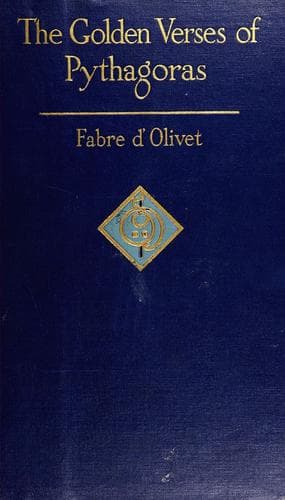
The golden verses of PythagorasFabre d'Olivet, Antoine
Religion
The golden verses of Pythagoras
Fabre d'Olivet, Antoine
Poetry -- History and criticism; Pythagoras and Pythagorean school
One can see by these few words that the ancient sages did not give to
Destiny the universal influence that certain philosophers and
particularly the Stoics gave to it later on; but they considered it
only as exercising its empire over matter. It is necessary to believe
that since the followers of the Porch had defined it as a chain of
causes, by virtue of which the past has taken place, the present
exists, and the future is to be realized[298]; or still better, as the
rule of the law by which the Universe is governed[299]; one must
believe, I say, that these philosophers confounded Destiny with
Providence, and did not distinguish the effect from its cause, since
these definitions conform only with the fundamental law of which
destiny is but an emanation. This confusion of words had to produce
and in fact did produce, among the Stoics, an inversion of ideas which
was the most unfortunate result[300]; for, as they established,
according to their system, a chain of good and evil that nothing could
either alter or break, one easily inferred that the Universe being
subject to the attraction of a blind fatality, all actions are here
necessarily determined in advance, forced, and thereafter indifferent
in themselves; so that good and evil, virtue and vice, are vain words,
things whose existence is purely ideal and relative.
The Stoics would have evaded these calamitous results if, like
Pythagoras, they had admitted the two motives of which I have spoken,
Necessity and Power; and if, far from instituting Necessity alone as
absolute master of the Universe, under the name of Destiny or
Fatality, they had seen it balanced by the Power of the Will, and
subject to the Providential Cause whence all emanates. The disciples
of Plato would also have evaded many errors, if they had clearly
understood this concatenation of the two opposed principles, from
which results universal equilibrium; but following certain false
interpretations of the doctrine of their master regarding the soul of
matter, they had imagined that this soul was no other than Necessity
by which it is ruled[301]; so that, according to them, this soul being
inherent in matter, and bad in itself, gave to Evil a necessary
existence: a dogma quite formidable, since it makes the world to be
considered as the theatre of a struggle without beginning or end,
between Providence, principle of Good, and the soul of matter,
principle of Evil. The greatest mistake of the Platonists, exactly
contrary to that of the Stoics, was in having confused the free power
of the Will with the divine Providence, in having instituted it for
the principle of good and thus being put in position of maintaining
that there are two souls in the world, a beneficent one, God, and a
malefic one, Matter. This system, approved of by many celebrated men
of antiquity and which Beausobre assures was the most widely
received,[302] offers, as I have observed, the very great disadvantage
Public-domain text, read in full here on John Shaqi.
Reviews
Reviews
No reviews yet
Be the first to share your thoughts on this work.
Elsewhere in the archive
Join the Discussion
Join the discussion
Sign in to leave a comment or review.
Sign InorCreate an account