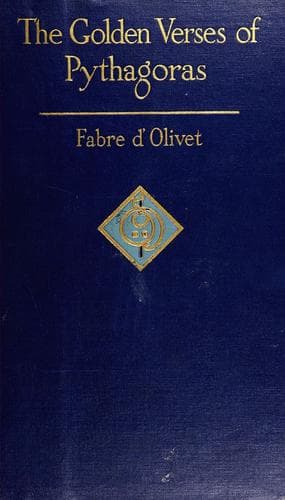
The golden verses of PythagorasFabre d'Olivet, Antoine
Religion
The golden verses of Pythagoras
Fabre d'Olivet, Antoine
Poetry -- History and criticism; Pythagoras and Pythagorean school
It seems that Lysis, foreseeing the wrong inductions that would be
drawn from what he had said, and as if he had a presentiment that one
would not fail to generalize the influence of Necessity upon the
actions of men, may have wished beforehand to oppose himself to the
destructive dogma of fatality, by establishing the empire of the Will
over the passions. This is in the doctrine of Pythagoras the real
foundation of the liberty of man: for, according to this philosopher,
no one is free, only he who knows how to master himself,[315] and the
yoke of the passions is much heavier and more difficult to throw off
than that of the most cruel tyrants. Pythagoras, however, did not,
according to Hierocles, prescribe destroying the passions, as the
Stoics taught in late times; but only to watch over them and repress
excess in them, because all excess is vicious.[316] He regarded the
passions as useful to man, and although produced in principle by
Necessity, and given by an irresistible destiny, as nevertheless
submissive in their use to the free power of the Will. Plato had well
realized this truth and had forcibly indicated it in many passages of
his works: one finds it chiefly in the second dialogue of Hippias,
where this philosopher shows, evidently without seeming to have the
design, that man good or bad, virtuous or criminal, truthful or false,
is only such by the power of his will, and that the passion which
carries him to virtue or to vice, to truth or falsehood, is nothing in
itself; so that no man is bad, only by the faculty which he has of
being good; nor good, only by the faculty which he has of being bad.
Public-domain text, read in full here on John Shaqi.
Reviews
Reviews
No reviews yet
Be the first to share your thoughts on this work.
Elsewhere in the archive
Join the Discussion
Join the discussion
Sign in to leave a comment or review.
Sign InorCreate an account