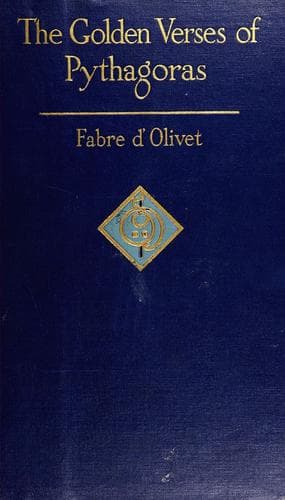
The golden verses of PythagorasFabre d'Olivet, Antoine
Religion
The golden verses of Pythagoras
Fabre d'Olivet, Antoine
Poetry -- History and criticism; Pythagoras and Pythagorean school
whatever fashion they might deduce it by their system, they could not
avoid establishing an absolute fatality, destructive to the liberty of
man, which by depriving it of morality of actions, by confounding vice
and virtue, ignorance and wisdom, made of the Universe no more than a
frightful chaos. In vain these had thrust back the reproach and
claimed that the inference was false; their adversaries pursuing them
on their own ground cried out to them: If the principle that you admit
is good, whence comes it that men are wicked and miserable?[343] If
this unique principle is bad, whence emerge goodness and virtue?[344]
If nature is the expression of this sole principle, how is it not
constant and why does its government sow goodness and evil?[345] The
materialists had recourse vainly to a certain deviation in atoms,[346]
and the spiritualists, to a certain adjuvant cause quite similar to
efficacious grace[347]; the theosophists would never have renounced
them if they had not enclosed them in a syllogistic circle, by making
them admit, sometimes that the unique and all-powerful Principle
cannot think of everything,[348] sometimes that vice is useful and
that without it there would be no virtue[349]; paradoxes of which they
had no trouble demonstrating the absurdity and the revolting
inferences.[350]
Take a survey of all the nations of the world, peruse all the books
that you please, and you will find the liberty of man, the free will
of his actions, the influence of his will over his passions, only in
the theosophical tradition. Wherever you see physical or metaphysical
systems, doctrines of whatever kind they may be, founded upon a sole
principle of the material or spiritual Universe, you can conclude
boldly that absolute fatality results from it and that their authors
find themselves in need of making two things one: or of explaining the
origin of good and evil, which is impossible; or of establishing the
free will _a priori_, which is a manifest contradiction of their
reasonings. If you care to penetrate into metaphysical depths, examine
this decisive point upon this matter. Moses founded his cult upon the
Unity of God and he explained the origin of evil; but he found himself
forced by the very nature of this formidable mystery to envelop his
explanation with such a veil, that it remained impenetrable for all
those who had not received the traditional revelation; so that the
liberty of man existed in his cult only by favour of theosophical
tradition, and that it became weaker and disappeared entirely from it
with this same tradition, the two opposed sects of the Pharisees and
Sadducees which divided the cult prove this.[351] The former, attached
to the tradition and allegorizing the text of the _Sepher_,[352]
admitted the free will[353]; the others, on the contrary, rejecting it
and following the literal meaning, established an irresistible destiny
to which all was subjected. The most orthodox Hebrews, and those even
Public-domain text, read in full here on John Shaqi.
Reviews
Reviews
No reviews yet
Be the first to share your thoughts on this work.
Elsewhere in the archive
Join the Discussion
Join the discussion
Sign in to leave a comment or review.
Sign InorCreate an account