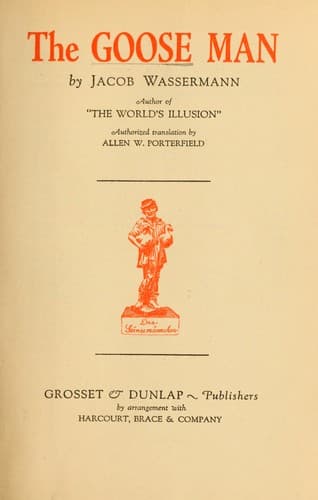
Composers -- Fiction; German fiction -- Translations into English; Germany -- Fiction
“He plundered me; he took my last cent, and then acted as if it were my
damned duty to go through fire for his baronical excellency,” screamed
Herr Carovius. “Before I came to know him I was a well-to-do man; I
could enjoy myself; I could reap the higher pleasures of human
existence. To-day I am ruined. My money is wasted, my house is burdened
with mortgages, my peace of mind has gone plumb to the Devil. Two
hundred and seventy-six thousand marks is what the young man owes me and
my business friends. Yes—two hundred and seventy-six thousand marks,
including interest and interest on the interest, all neatly noted down
and signed up by the duly authorised parties. Am I to let him slam the
door in my face because of his indebtedness to me? I think you will see
yourself that that cannot be expected of me. He at least owes me a
little respect for what I have done for him.”
The Baroness had listened to all this with folded hands and unfixed
eyes. But the close of the story was too much for her: she threw herself
on a great divan, overcome—for the time being—with worry and maternal
weakness. A grin strayed across Herr Carovius’s face. He twirled his
Calabrian headpiece in his hands, and let his leery eyes wander about
the walls. Then it was that he caught sight of Dorothea, whom he had
thus far failed to see in his intoxication of wrath and rapture.
When Herr Carovius entered, Dorothea, out of discretion rather than with
serious intent, had made herself as small as possible in the most remote
corner of the room. Trembling with curious excitement, she had wished to
evade the eye of her uncle Carovius, for in very truth she was ashamed
of him.
She regarded him as a sort of comic freak, who, though he had enough to
live on, could not be said to be in the best of circumstances. When he
rolled the sum the Auffenberg family owed him from his tongue, she was
filled with astonishment and delight, and from then on she took a
totally different view of him.
During the last few years Herr Carovius had seen very little of
Dorothea. Whenever he had met her, she had passed by him in great haste.
He knew that she was taking violin lessons: he had often heard her
screechy fiddling on the stairs and out in the hall.
He fixed his eyes on her, and exclaimed: “Well I’m a son-of-a-gun if
there isn’t Döderlein’s daughter! How did you get here? Aha, you are
going about and showing the people what you can do! I should think you
and your creator would have had enough of music by this time.”
The Baroness, recalling that the young girl was present, raised her
eyes and looked at Dorothea reproachfully. For the first time in her
life she felt that the resources she had managed to extract from a life
of neglect were about exhausted; for the first time in her life she felt
a shudder at the thought of her musical stupefactions.
Public-domain text, read in full here on John Shaqi.
Reviews
Reviews
No reviews yet
Be the first to share your thoughts on this work.
Elsewhere in the archive
Join the Discussion
Join the discussion
Sign in to leave a comment or review.
Sign InorCreate an account