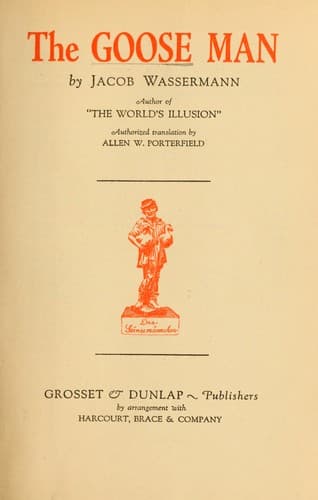
Composers -- Fiction; German fiction -- Translations into English; Germany -- Fiction
In his eyes nothing was of value except the law, unwritten to be sure,
but of immemorial duration, that subjects the little to the big, the
weak to the strong, the immature to the experienced, the poor to the
rich. In accordance with this law humanity for him was divided into two
camps: those who submitted to the law, and the undesirable citizens who
rebelled against the law.
And of these undesirable citizens his son Eberhard was the most
undesirable.
With this stinging, painful thorn in his flesh, oppressed by the feeling
of loneliness in the very midst of a noisy, fraudulent activity, and
filled with an ever-increasing detestation of the superfluity and
consequent effeminacy of his daily existence, he had created out of the
figure of his son a picture of evil incarnate.
He visualised him in dissipation and depravity of every kind and degree;
he saw him sinking lower and lower, a traitor to his family name; as if
in a dream that appeases the sense of obscene horror, he saw him in
league with the abandoned and proscribed, associating with thieves,
street bandits, high-flying swindlers, counterfeiters, anarchists,
prostitutes, and literati. He saw him in dirty dives, a fugitive from
justice wandering along the highway, drunk in a gambling den, a beggar
at a fair, and a prisoner at the bar.
His determination to wait until the degenerate representative of the
human family had been stigmatised by all the world he finally abandoned.
His impatience to find peace, to throw off the mask, to rid himself
completely of all entanglements, dissimulation, and the life of luxury
to which he had been accustomed became so great, that he looked forward
to the day that would eventually mark his release as the day of a new
birth.
But why did he hesitate? Was there still an element of doubt in his
breast? Was there still slumbering, deep down in the regions of his
heart that were inaccessible to bitterness and revenge, another picture
of his son? Why did he hesitate from week to week, from month to month?
In the meantime he had donated great fortunes to poor houses, hospitals,
foundations, and similar causes. He wanted to give away other millions,
at least so much that his heirs would receive only the gleanings of what
had once been a field of riches. Emilia was to be given the income from
the breweries and the country estates.
Public-domain text, read in full here on John Shaqi.
Reviews
Reviews
No reviews yet
Be the first to share your thoughts on this work.
Elsewhere in the archive
Join the Discussion
Join the discussion
Sign in to leave a comment or review.
Sign InorCreate an account