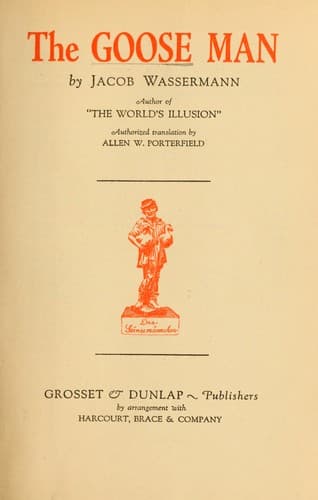
Composers -- Fiction; German fiction -- Translations into English; Germany -- Fiction
One evening he left a little inn which he had entered to get something
to eat and drink. It was eight miles to Dortmund, where he planned to
stay over night. He had left the main road, when all of a sudden the
fire from the blast-furnaces leaped up, giving the mist the appearance
of a blood-red sea. Miners were coming in to the village; in the light
of the furnaces their tired, blackened faces looked like so many
demoniac caricatures. Far or near, it was impossible to say, a horse
could be seen drawing a car over shining rails. On it stood a man
flourishing his whip. Beast, man, and car all seemed to be of colossal
size; the “gee” and “haw” of the driver sounded like the mad cries of a
spectre; the iron sounds from the forges resembled the bellowing of
tormented creatures.
Daniel had found what he had been looking for: he had found the mournful
melody that had driven him away the day Eleanore died. He had, to be
sure, put it on the paper then and there, but it had remained without
consequence: it had been buried in the grave with Eleanore.
Now it had arisen, and its soul—its consequence—had arisen with it; it
was expanded into a wonderful arch, arranged and limbed like a body, and
filled as the world is full.
Music had been born to him again from the machine, from the world of
machinery.
IV
Jason Philip Schimmelweis had been obliged to give up his house by the
museum bridge. He could not pay the rent; his business was ruined. By a
mere coincident it came about that the house on the Corn Market had a
cheap apartment that was vacant, and he took it. It was the same house
in which he lived when he made so much money twenty years ago.
Was Jason Philip no longer in touch with modern business methods? Had he
become too old and infirm to make the public hungry for literary
nourishment? Were his advertisements without allurement, his baits
without scent? No one felt inclined to buy expensive lexicons and
editions de luxe on the instalment plan. The rich old fellows with a
nose for dubious reading matter never came around any more. Jason Philip
had become a dilatory debtor; the publishers no longer gave him books on
approval; he was placed on the black list.
He took to abusing modern writers, contending that it was no wonder that
the writing of books was left exclusively to good-for-nothing subjects
of the Empire, for the whole nation was suffering from cerebral atrophy.
But his reasoning was of no avail; his business collapse was imminent;
in a jiffy it was a hard reality. A man by the name of Rindskopf bought
his stock and furnishings at brokers’ prices, and the firm of Jason
Philip Schimmelweis had ceased to exist.
In his distress Jason Philip appealed to the Liberal party. He boasted
of his friendship with the former leader of the party, Baron von
Auffenberg, but this only made matters worse: one renegade was depending
upon the support of another. This was natural: birds of a feather flock
together.
Public-domain text, read in full here on John Shaqi.
Reviews
Reviews
No reviews yet
Be the first to share your thoughts on this work.
Elsewhere in the archive
Join the Discussion
Join the discussion
Sign in to leave a comment or review.
Sign InorCreate an account