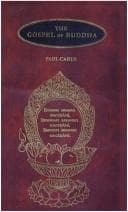
The Gospel of Buddha, Compiled from Ancient RecordsCarus, Paul
ReligionEastern
The Gospel of Buddha, Compiled from Ancient Records
Carus, Paul
Buddhism; Christianity and other religions -- Buddhism; Gautama Buddha; Gautama Buddha -- Teachings
"By love of truth the sincere escape iniquity. Like the elephant
well subdued and quiet, who permits the king to mount on his
trunk, thus the man that reveres righteousness will endure
faithfully throughout his life." 16
Rāhula hearing these words was filled with deep sorrow; he never
again gave any occasion for complaint, and forthwith he
sanctified his life by earnest exertions. 17
LVII.
THE SERMON ON ABUSE.
And the Blessed One observed the ways of society and noticed how
much misery came from malignity and foolish offences done only to
gratify vanity and self-seeking pride. 1
And the Buddha said: "If a man foolishly does me wrong, I will
return to him the protection of my ungrudging love; the more evil
comes from him, the more good shall go from me; the fragrance of
goodness always comes to me, and the harmful air of evil goes to
him." 2
A foolish man learning that the Buddha observed the principle of
great love which commends the return of good for evil, came and
abused him. The Buddha was silent, pitying his folly. 3
When the man had finished his abuse, the Buddha asked him,
saying: "Son, if a man declined to accept a present made to him,
to whom would it belong?" And he answered: "In that case it would
belong to the man who offered it." 4
"My son," said the Buddha, "thou hast railed at me, but I decline
to accept thy abuse, and request thee to keep it thyself. Will it
not be a source of misery to thee? As the echo belongs to the
sound, and the shadow to the substance, so misery will overtake
the evil-doer without fail." 5
The abuser made no reply, and Buddha continued: 6
"A wicked man who reproaches a virtuous one is like one who looks
up and spits at heaven; the spittle soils not the heaven, but
comes back and defiles his own person. 7
"The slanderer is like one who flings dust at another when the
wind is contrary; the dust does but return on him who threw it.
The virtuous man cannot be hurt and the misery that the other
would inflict comes back on himself." 8
The abuser went away ashamed, but he came again and took refuge
in the Buddha, the Dharma, and the Sangha. 9
LVIII.
THE BUDDHA REPLIES TO THE DEVA.
On a certain day when the Blessed One dwelt at Jetavana, the
garden of Anāthapindika, a celestial deva came to him in the
shape of a Brahman whose countenance was bright and whose
garments were white like snow. The deva asked questions which the
Blessed One answered, 1
Public-domain text, read in full here on John Shaqi.
Reviews
Reviews
No reviews yet
Be the first to share your thoughts on this work.
Elsewhere in the archive
Join the Discussion
Join the discussion
Sign in to leave a comment or review.
Sign InorCreate an account