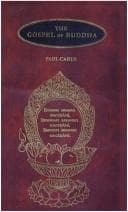
The Gospel of Buddha, Compiled from Ancient RecordsCarus, Paul
ReligionEastern
The Gospel of Buddha, Compiled from Ancient Records
Carus, Paul
Buddhism; Christianity and other religions -- Buddhism; Gautama Buddha; Gautama Buddha -- Teachings
"O Master, thou all-seeing one, we all wish to learn; our ears
are ready to hear, thou art our teacher, thou art incomparable.
Cut off our doubt, inform us of the blessed Dharma, O thou of
great understanding; speak in the midst of us, O thou who art
all-seeing, as is the thousand-eyed Lord of the gods. 2
"We will ask the muni of great understanding, who has crossed the
stream, gone to the other shore, is blessed and of a firm mind:
How does a bhikkhu wander rightly in the world, after having gone
out from his house and driven away desire?" 3
The Buddha said: 4
"Let the bhikkhu subdue his passion for human and celestial
pleasures, then, having conquered existence, he will command the
Dharma. Such a one will wander rightly in the world. 5
"He whose lusts have been destroyed, who is free from pride, who
has overcome all the ways of passion, is subdued, perfectly
happy, and of a firm mind. Such a one will wander rightly in the
world. 6
"Faithful is he who is possessed of knowledge, seeing the way
that leads to Nirvāna; he who is not a partisan; he who is pure
and virtuous, and has removed the veil from his eyes. Such a one
will wander rightly in the world." 7
Said the bhikkhus: "Certainly, O Bhagavat, it is so: whichever
bhikkhu lives in this way, subdued and having overcome all bonds,
such a one will wander rightly in the world." 8
The Blessed One said: 9
"Whatever is to be done by him who aspires to attain the
tranquillity of Nirvāna let him be able and upright,
conscientious and gentle, and not proud. 10
"Let a man's pleasure be the Dharma, let him delight in the
Dharma, let him stand fast in the Dharma, let him know how to
inquire into the Dharma, let him not raise any dispute that
pollutes the Dharma, and let him spend his time in pondering on
the well-spoken truths of the Dharma. 11
"A treasure that is laid up in a deep pit profits nothing and may
easily be lost. The real treasure that is laid up through charity
and piety, temperance, self-control, or deeds of merit, is hid
secure and cannot pass away. It is never gained by despoiling or
wronging others, and no thief can steal it. A man, when he dies,
must leave the fleeting wealth of the world, but this treasure of
virtuous acts he takes with him. Let the wise do good deeds; they
are a treasure that can never be lost." 12
And the bhikkhus praised the wisdom of the Tathāgata: 13
Public-domain text, read in full here on John Shaqi.
Reviews
Reviews
No reviews yet
Be the first to share your thoughts on this work.
Elsewhere in the archive
Join the Discussion
Join the discussion
Sign in to leave a comment or review.
Sign InorCreate an account