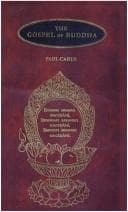
The Gospel of Buddha, Compiled from Ancient RecordsCarus, Paul
ReligionEastern
The Gospel of Buddha, Compiled from Ancient Records
Carus, Paul
Buddhism; Christianity and other religions -- Buddhism; Gautama Buddha; Gautama Buddha -- Teachings
Jhā'na, _p._, Dhyā'na, _skt._, intuition, beatic vision, ecstasy,
rapture, the result of samādhi. Buddha did not recommend trances as
means of religious devotion, urging that deliverance can be obtained
only by the recognition of the four noble truths and walking on the
noble eightfold path, but he did not disturb those who took delight in
ecstasies and beatific visions. Buddha's interpretation of the Dhyāna is
not losing consciousness but a self-possessed and purposive eradication
of egotism. There are four Dhyānas, the first being a state of joy and
gladness born of seclusion full of investigation and reflexion; the
second one, born of deep tranquillity without reflexion or
investigation, the third one brings the destruction of passion, while
the fourth one consists in pure equanimity, making an end of sorrow.
[See Rhys Davids's B. pp. 175--176.] In the Fo-Sho-hing-tsang-king, the
Dhyāna is mentioned twice only: first, III, 12, vv. 960--978, where
Ārāda sets forth the doctrine of the four Dhyānas which is not approved
of by Buddha, and secondly, at Buddha's death; when his mind is said to
have passed through all the Dhyānas.
Ji'na, _p._ and _skt._, the Conqueror, an honorary title of Buddha. The
Jains use the term with preference as an appellative of Vardhamāna whom
they revere as their Buddha.
Jī'vaka, _p._ and _skt._, physician to king Bimbisāra. According to
tradition he was the son of king Bimbisāra and the courtesan Salavatī.
We read in Mahāvagga VIII that after his birth he was exposed but saved;
then he became a most famous physician and cured Buddha of a troublesome
disease contracted by wearing cast off rags. He was an ardent disciple
of Buddha and prevailed upon him to allow the Bhikkhus to wear lay
robes.
Jo'tikkha, _p._, name of a householder, son of Subhadda.
Kālā'ma, _p._ and _skt._, (see Alāra).
Ka'nthaka, prince Siddhattha's horse.
Kapilava'tthu, _p._, Kapilava'stu, _skt._, the capital of the Sakyas,
the birthplace of Buddha.
Public-domain text, read in full here on John Shaqi.
Reviews
Reviews
No reviews yet
Be the first to share your thoughts on this work.
Elsewhere in the archive
Join the Discussion
Join the discussion
Sign in to leave a comment or review.
Sign InorCreate an account