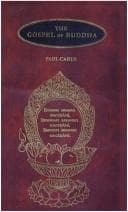
The Gospel of Buddha, Compiled from Ancient RecordsCarus, Paul
ReligionEastern
The Gospel of Buddha, Compiled from Ancient Records
Carus, Paul
Buddhism; Christianity and other religions -- Buddhism; Gautama Buddha; Gautama Buddha -- Teachings
[Names and terms must be looked up in the Glossary, where references
to pages of the present book are separated by a dash from the explanation.]
REMARKS ON THE ILLUSTRATIONS OF THE GOSPEL OF BUDDHA.
Upon the task of illustrating _The Gospel of Buddha_, I have spent three
years, the first of which was entirely devoted to preparation. By the
kind assistance of Dr. Hans Schnorr von Carolsfeld, Director of the
Royal Court and State Library at Munich, I was enabled to make very
extensive use of the treasures of this institution, and I am under great
obligations to him for the courtesies extended to me. Above all I
endeavored to obtain a solid foundation for my work by acquiring a clear
conception of the personality of the Buddha from religious, historical
and artistic standpoints and by familiarizing myself with all the
Buddhist dogmas, symbols and religious observances.
Detailed studies of Indian costume, armor, decoration, architecture and
the arrangement of dwellings and gardens, as well as the fauna and flora
of the country, were likewise indispensable. Not only modern documents,
explorers' reports and photographs of ancient ruins provided me with
available material, but also some old Dutch works of the seventeenth
century.
The two main sources of our knowledge of ancient Buddhist art will
always remain the monuments of Gandhāra, and the cave dwellings of
Buddhist monks in Ajantā and other places. The former bear witness to
the extraordinary influence of Greek art on Buddhism; and the latter are
rich in wonderful fresco paintings of the classical period of Buddhist
art. A description of all the caves as well as a selection of the best
mural paintings in colored pictures are to be found in Griffith's
elegant work _The Paintings in the Buddhist Cave Temples of Ajanta_[1]
and some reproductions from it have been made further accessible in Dr.
Carus's _Portfolio of Buddhist Art_.[2] The two great expositions in
Munich, "Japan and Eastern Asia in Art" and "Expositions of the
Masterpieces of Mohammedan Art," 1910, were very instructive to me from
the point of view of art history, containing invaluable material
conveniently arranged from the great museums, royal treasures and
private collections from London, Paris, Berlin, Vienna, St. Petersburg,
Moscow, and Cairo. In the former the great wave of the marvelous
Buddhist faith which had been flowing towards China for two millenniums
and which had brought new life from China to Japan was evidenced in many
rare pieces. Yet almost more fruitful for my purpose was the exposition
of Mohammedan art. It displayed wonderful Persian and Indian book-making
and lacquer work, tapestries, ceramics, fabrics, armor and metal work.
To be sure these were exclusively of Mohammedan manufacture, but many
large museums and institutions (native and foreign), collectors and
explorers had sent also chests of Buddhist works, which, not falling
within its compass, had been excluded from the exhibition, but were
Public-domain text, read in full here on John Shaqi.
Reviews
Reviews
No reviews yet
Be the first to share your thoughts on this work.
Elsewhere in the archive
Join the Discussion
Join the discussion
Sign in to leave a comment or review.
Sign InorCreate an account