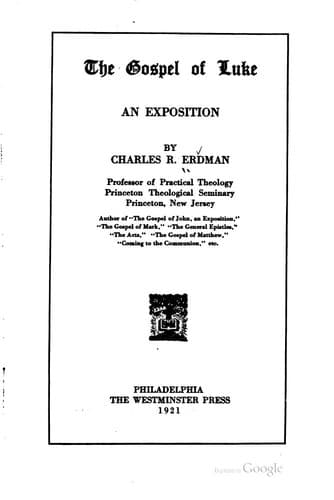
The Gospel of Luke, an expositionErdman, Charles Rosenbury
Religion
The Gospel of Luke, an exposition
Erdman, Charles Rosenbury
Bible. Luke -- Commentaries
Some one among his hearers asked him the question, “Lord, are they few
that are saved?” He did not reply directly but his answer implied that
many Jews who expected to be saved would be lost and many Gentiles whom
the Jews expected to be lost would be saved. Jesus likened the blessings
of his Kingdom to a banquet served in a palace. The door into this palace
is narrow, and many who are invited refuse to pass in thereby; after a
time this door is shut, and then those who before have refused to enter,
intreat the Master of the house to reopen it, but in vain; they are
forever excluded, and are overwhelmed with remorse and chagrin. The narrow
door is that of repentance and faith in Christ; the opportunity for
entrance is present but not endless; those who reject Christ will be
excluded from his Kingdom; among these will be many whose folly will be
specially apparent. In the parable they are represented as pleading for
entrance, and on the very ground which condemned them. They are pictured
as saying that they had known Christ well; they had eaten in his presence
and he had taught in their streets. Why, then, had they not accepted him?
These privileges only increase their guilt; and the Lord refused to
recognize them as his own. Thus did Jesus describe the exclusion from his
Kingdom of many Jews; and he added the equally surprising statement of the
reception of Gentiles: “They shall come from the east and west, and from
the north and south, and shall sit down in the kingdom of God.”
Thus Jesus gave a very practical turn to the question which had been asked
in mere curiosity. It is not important to know exactly how many will be
saved; it is for each who hears the gospel to place himself in that
number, now and at any cost. It is not enough that one lives in a
Christian land, and in a religious home, and possesses knowledge of saving
truth; each must repent and accept Christ for himself. The sad truth is
that many who, like the Jews, have the largest religious opportunities are
the furthest from salvation: “There are last who shall be first, and there
are first who shall be last.”
2. The Message to Herod and the Lament Over Jerusalem. Ch. 13:31-35
Public-domain text, read in full here on John Shaqi.
Reviews
Reviews
No reviews yet
Be the first to share your thoughts on this work.
Elsewhere in the archive
Join the Discussion
Join the discussion
Sign in to leave a comment or review.
Sign InorCreate an account